Aleph Alpha releases open-weight Kolibri: 78.1B-parameter MoE activating 3.46B per token
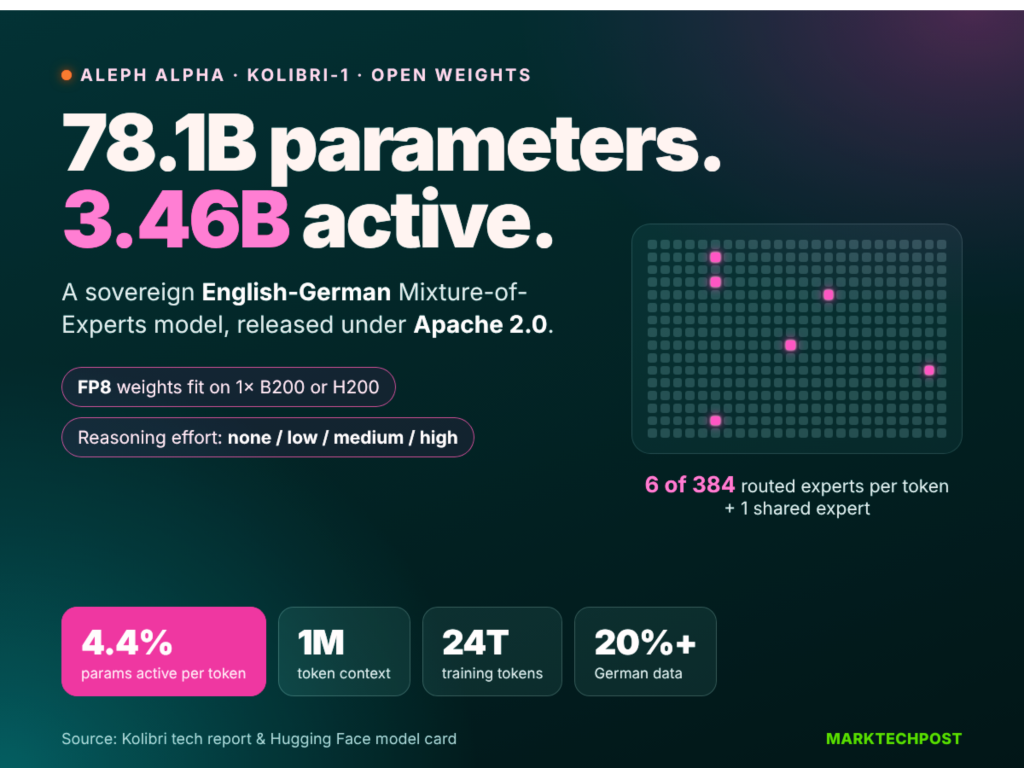
According to an October 4, 2026 MarkTechPost report, Aleph Alpha released Kolibri-1, an English-German bilingual open-weight MoE model with 78.1 billion total parameters activating only 3.46 billion per token, supporting up to 1,048,576-token context and four inference-intensity levels, released on Hugging Face under Apache 2.0, with an FP8 checkpoint of about 78GB servable on a single B200 or H200 via vLLM.
What changed
According to an October 4, 2026 MarkTechPost report, the German team Aleph Alpha released the open-weight model Kolibri (Kolibri-1), positioned as an English-German bilingual mixture-of-experts (MoE) language model aimed at sovereign deployments in regulated sectors such as public administration, industry, and aerospace. The report says it has 78.1 billion total parameters and activates only 3.46 billion per token (about 4.4%): each MoE layer uses a sigmoid router to select top 6 of 384 routed experts, plus 1 shared expert, with load balancing via Exact Quantile Balancing and Load-Error Injection. The model stacks 50 Transformer blocks with width 2560; grouped-query attention uses 48 query heads and 4 KV heads; every fifth block is full attention without positional encoding, while the other 40 blocks use sliding-window attention covering the previous 512 tokens with RoPE, so only 10 layers' KV cache grows with context. The context limit is reported at 1,048,576 tokens, and inference intensity can be set per request to none, low, medium, or high. On training, the report says pretraining covered 20T tokens on 768 NVIDIA B200s, midtraining 3.44T tokens (sequence length 65,536), a long-context stage of 201B tokens (sequence length 262,144), plus over 2T additional German tokens; post-training combined supervised fine-tuning with reinforcement learning on over 1.2 million internal tasks. The license is Apache 2.0, with weights released on Hugging Face; the FP8 checkpoint is about 78GB and can run on a single B200, B300, or H200, or two H100 SXM5s, served through vLLM with dedicated inference and tool-calling parsers. Reported benchmark comparisons show 75.5 overall English and 70.8 overall German, with BFCL v4 at 61.4, below the compared Qwen3.5. The above parameters, benchmarks, and deployment details are relayed from the original report and technical report and have not been independently reproduced.
What it means for developers
From a developer's perspective, the value of this news centers on three points. First is the combination of license and self-hosting: the report says the weights are released under Apache 2.0, which gives clearer authorization room than the common practice of open weights with commercial restrictions, but the license terms should be checked against the original Hugging Face model card and repository license rather than inferred solely from the report; also note that weight availability does not mean the training data, tokenizer, or inference package are under the same license. Second is the cost structure from sparsity: 78.1 billion total parameters and 3.46 billion activated mean memory footprint scales with total parameters while compute cost scales with activated parameters; the report says the FP8 checkpoint of about 78GB can run on a single B200/H200, a feasible self-hosting starting point for teams that already have single-card high-memory nodes, but real throughput and concurrency still depend on memory bandwidth, KV cache precision, and batch size, and need self-testing. Third is hybrid attention and million-token context: sliding-window layers keep a fixed KV cache with only 10 layers growing with context, and the team says that at equal compute it can support 4 times the sequence length of full-attention schemes; if true, the context economics for long documents and industrial RAG would be clearly better than same-scale dense models, but this is a vendor claim and needs validation of effective context on one's own document distribution rather than just the upper limit. In addition, the English-German bilingual positioning and German-optimized tokenizer (the report says 4.90 bytes per German token, using about 11.2% fewer tokens than the compared tokenizer) show its strength lies in German; businesses mainly in Chinese should not infer Chinese capability from this, as the report gives no Chinese evaluation. It must be clear: as of this catalog check, the Kolibri-1 version does not appear in KimiSeek's live model catalog, so the reported weight and inference service availability refers to the release on Aleph Alpha's and Hugging Face's side, not to this site having launched it.
Integration and evaluation
The following are suggestions and conditional analysis, not verified facts. Suggestion one: decide on license and compliance prerequisites before performance. The practical choice is to check the LICENSE file in the Hugging Face repository, usage restrictions in the model card, and the license of the aleph-alpha-inference package itself before deciding whether to include it as a production dependency. When the workload involves local processing of regulated data and the team has single B200/H200-class memory nodes, self-hosting is more valuable than calling an external API; if that precondition is not met (for example, only consumer-grade or multiple small-memory cards), abandon by a quantifiable standard: passing means successfully loading the FP8 checkpoint on target hardware and producing stable output; loading failure or needing memory expansion beyond budget means do not proceed to the next round. Suggestion two: before switching or adopting, run a controlled evaluation against existing models using your own German or mixed English-German corpus. A key variable to choose is the inference-intensity level (none/low/medium/high) and KV cache precision, because it directly changes per-request cost and latency; when the task is long-document extraction and latency tolerance is high, raising inference intensity may yield quality gains, while for high-concurrency short Q&A, low intensity with longer batching is more economical. Evaluation criteria should be measurable: on a fixed 200 to 500 item German long-document QA set, compare accuracy and end-to-end latency per thousand tokens for each level, and adopt a higher level only when the accuracy gain exceeds the latency and cost increase. Suggestion three: long-context capability must be verified by 'effective window', not the upper limit. The practical choice is to launch with the default 262,144 context first, then gradually open to a larger window by setting max-model-len and overriding max_position_embeddings; the precondition is that the task truly needs continuous dependencies across a million tokens, because if retrieval results are already shorter than one hundred thousand tokens, raising the limit only increases KV cache cost. A quantifiable standard is to measure key-information recall across a length gradient (such as 32k, 128k, 512k); if recall drops significantly at some length, use below that length as the practical limit. Suggestion four: tool calling and agent scenarios should be stress-tested separately. The report says its BFCL v4 score is lower than the compared Qwen model, while the agentic average is close to its rival, indicating gaps may vary greatly across agent subtasks; the practical choice is to keep the existing model as the main tool-calling path and use Kolibri for German retrieval and generation, or vice versa. The precondition is that the team has a regression tool-calling test set; a quantifiable standard is call success rate and parameter accuracy on your own tool schema, and if significantly lower than the current model, do not migrate the main path.
Limits and open questions
First, it must be clearly stated: as of this catalog check, Kolibri-1 does not appear in KimiSeek's live model catalog, and the weights, inference package, and deployment methods described here refer to Aleph Alpha and its Hugging Face release, not to this site offering the model; any API availability statements in the report also refer only to the vendor side and should not be understood as this site's service. Second, all architecture, training, benchmark, and deployment numbers in this article come from the October 4, 2026 MarkTechPost report and the technical report and model card it relays, and have not been independently reproduced; the benchmark comparisons use vendor-built evaluation configurations, so cross-model horizontal comparability is limited and should not be the sole basis for selection. Third, the report gives no independent verification details for Chinese, code, or long-context scenarios, and capability in languages beyond the English-German positioning is unknown; its claim of '4 times the sequence length at equal compute' is a team statement and needs self-verification. Fourth, Apache 2.0 is a license statement for the released weights, and the specific scope (weights, tokenizer, inference package, training data) should be checked item by item against the original license and model card; one cannot directly infer the authorization scope of all components from 'open weights'. Fifth, being runnable on a single card and being production-ready are two different things, and peak concurrency, memory headroom, and the cost impact of inference-intensity levels all need real testing on target hardware. Sixth, prices, limits, and recommended sampling parameters in the report are information as of the release time and may change with subsequent versions; please refer to the latest content on the vendor and Hugging Face pages.