Cantina Releases apex-flash-1: An Open-Weight Vulnerability Research Model Fine-Tuned on GLM-5.3-Flash, Solving 40 of 60 Held-Out Tasks
According to an October 4, 2026 report by MarkTechPost, Cantina Security, together with Yeta Labs, released the open-weight model apex-flash-1, fine-tuned on GLM-5.3-Flash with GRPO and released on Hugging Face under the MIT license, self-reporting 40 of 60 held-out vulnerability tasks solved and roughly 640GB of VRAM needed for BF16 weights.
What changed
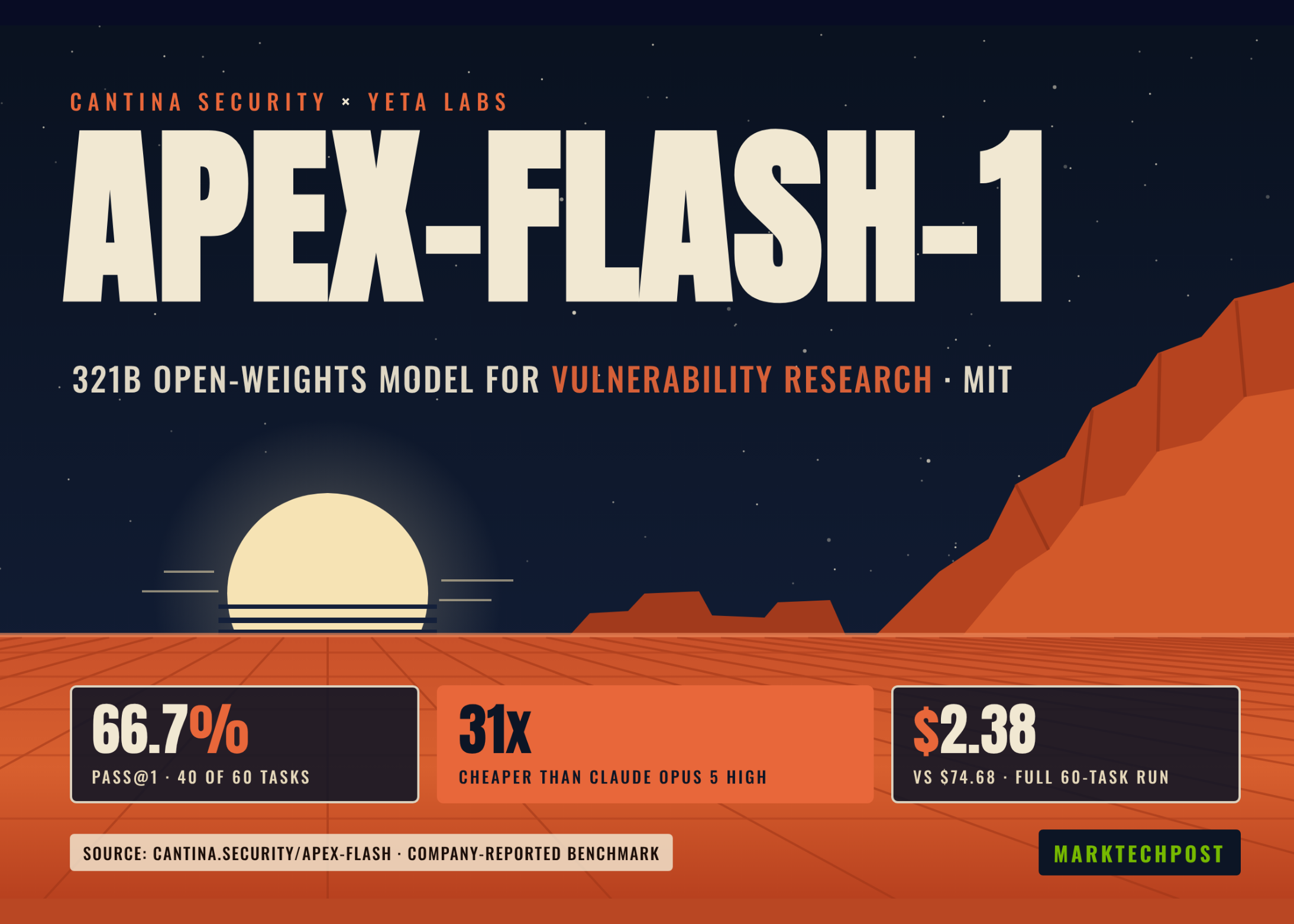
According to an October 4, 2026 report by MarkTechPost, Cantina Security, together with Yeta Labs, released apex-flash-1. The model is the product of reinforcement learning fine-tuning of Z.ai's GLM-5.3-Flash (MoE, about 320 billion total parameters and 18 billion activated), and weights have been released on Hugging Face under the MIT license. The report states a total parameter count of 321.3 billion, with training using GRPO, rank-256 LoRA and selective full-parameter training; the data consists of 150 tasks derived from 50 real vulnerability cases, each case containing three variants: guided white-box, focused white-box and focused black-box. Among case types, authorization/identity/permission-scope defects account for 72%, accounting and numerical-precision issues 18%, and the rest are time validation, business logic and SSRF. The report cites the model card as saying rollouts run in a Codex agent harness. On evaluation, Cantina selected 60 tasks from 20 held-out cases and ran one pass per model: apex-flash-1 solved 40/60 (66.7% pass@1, about $2.38), the base GLM-5.3-Flash 36/60 (60.0%, about $4.56), and Claude Opus 5 High 43/60 (71.7%, about $74.68). The report also mentions an experimental apex-flash-1-abliterated variant whose refusal behavior was modified and which was not separately evaluated. Cantina positions it as a worker model orchestrated by a larger model, aimed at defender scenarios with locally controlled deployment. It should be noted that the above benchmarks and costs are all vendor self-reported internal data.
What it means for developers
The impact on developers can be divided into three layers. The first is licensing and usage boundaries: the report says the weights are released under the MIT license, which is a different matter from "the weights can be downloaded"—MIT is a license term, and commercial use and redistribution paths are relatively clear, but the LICENSE and NOTICE in the official repository still govern, and the report does not itemize whether a separate usage policy is attached. The second is the deployment cost structure: the report says BF16 weights require about 640GB of VRAM, which is not something a single card can hold, so self-hosting requires multi-card nodes or quantized ports; the report mentions a community 4-bit port but gives no quality evaluation, and the impact of quantization on exploitation-type tasks is unknown and needs to be checked against one's own results. The third is task fit: 72% of the training data concentrates on authorization, identity and permission-scope defects, so performance on these tasks cannot be extrapolated to memory-safety, concurrency, cryptography or supply-chain vulnerabilities, and evaluation should be stratified by defect category rather than looking only at overall pass@1. In addition, the report positions the model as a "worker model" orchestrated by a larger model, implying that the intended integration is as an execution step within an agent harness, and how well the interface and tool-calling protocol align will directly affect usability. As for the current catalog state: apex-flash-1 has no exact match in the live KimiSeek catalog; if one needs to call its base GLM-5.3-Flash, an entry with that name exists in the catalog, but catalog information only indicates current callability and cannot serve as evidence for the reported benchmarks, prices or weights.
Integration and evaluation
The following are suggestions and conditional analysis, not statements of fact from the report. Suggestion one: run a small-sample comparison by defect category before deciding whether to invest in self-hosting. The specific change in the report is that 72% of the training data concentrates on authorization/identity/permission-scope defects; the corresponding decision is whether to use apex-flash-1 or the base GLM-5.3-Flash, with the precondition being whether the target tasks fall into these categories; the measurable evaluation criterion is to compare the pass@1 difference between the two on 20 to 30 authorization-type tasks held out by yourself, and if the improvement is less than about 5 percentage points, then the extra operational cost of multi-card deployment is not worth bearing. Suggestion two: set a tool-calling success threshold for agent integration. The report says rollouts run in a Codex agent harness and lists code reading, tool calling, exploit development and verification as target capabilities; the corresponding decision is to use it as an executor in an agent rather than a planner, with the precondition being that your harness tool schema is close to its training environment; the measurable evaluation criterion is to measure the format-validity rate and end-to-end completion rate over 50 real tool calls, and if the format-validity rate is below about 95%, add an output validation layer before integrating. Suggestion three (conditional): whether to choose a community 4-bit port when VRAM is insufficient. The report mentions an existing 4-bit port but no quality data; the corresponding decision is the trade-off between waiting for official quantization and adopting a community port, with the precondition being whether your task is more sensitive to numerical precision or to throughput; the measurable evaluation criterion is to run the same set of 60 tasks before and after quantization and compare the drop in the number solved, and if the drop exceeds 3 to 5 tasks, it is not suitable as a direct replacement for BF16 in automated vulnerability verification.
Limits and open questions
All benchmark data (66.7% pass@1, 40/60, about $2.38, etc.) are Cantina's self-reported internal results, with samples drawn from 20 held-out cases totaling 60 tasks, a small scale whose task-type distribution has not been fully disclosed, and no third party has reproduced them. The report does not disclose the evaluation's scoring rules, whether multiple attempts were allowed, or the criteria for "solving", and pass@1 may mean different things under different implementations. The apex-flash-1-abliterated variant was not separately evaluated, and the security impact of its modified refusal behavior is entirely unknown. On hardware requirements, the report's body says about 640GB, its comparison table about 642GB, and its parameter table says BF16 328GB—several numbers are inconsistent, so selection should be based on the actual weight file size in the official repository; the community 4-bit port has no quality data. As for this round of catalog checking, the version apex-flash-1 does not currently appear in the live KimiSeek catalog, and any API availability or calling cost mentioned in this article points to the vendor or a third-party provider and does not mean it can be called directly on this platform; its base GLM-5.3-Flash has an entry with the same name in the catalog, but that catalog information only reflects current callability and does not constitute corroboration of the reported benchmarks or prices. The report date is October 4, 2026, and the cost comparisons and conclusions therein are time-sensitive and should not be taken as the current state; for pricing information, refer to the official pricing pages.