Deep Principle releases Hydrogen-1.0: 753B science-focused model with open weights, servable on 8 GPUs with SGLang
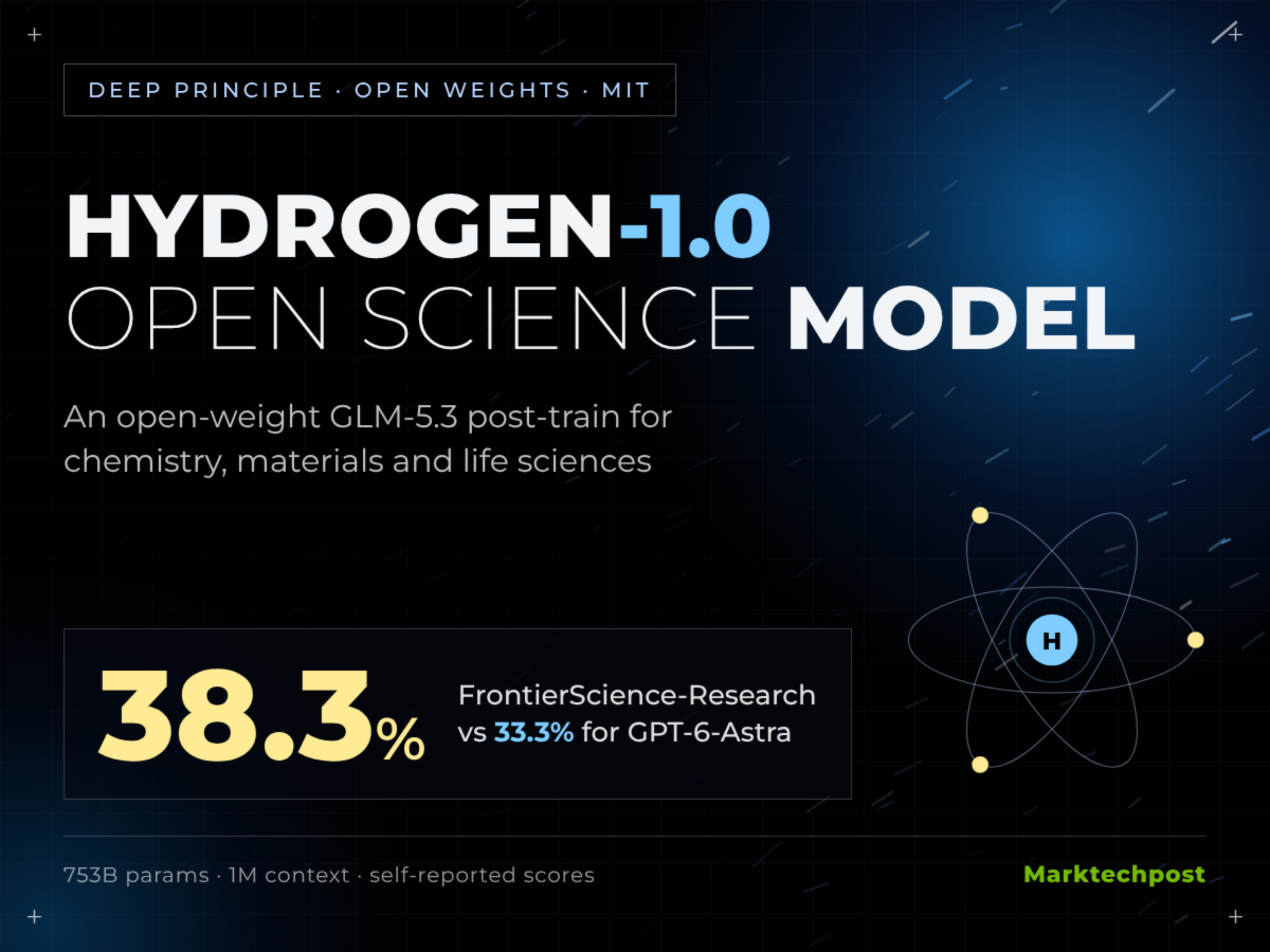
According to a MarkTechPost report on November 2, 2026, Hangzhou-based Deep Principle has released Hydrogen-1.0, post-trained from GLM-5.3, with 753B total parameters and a 1M context; the weights are reported to be open under an MIT license. In its own evaluation it scores 38.3% on FrontierScience-Research, above GPT-6-Astra's 33.3%, while trailing by 3.33 percentage points on NMR structure elucidation.
What changed
According to a MarkTechPost report dated November 2, 2026, Deep Principle, an AI for Materials company headquartered in Hangzhou, has released Hydrogen-1.0. The weights have been uploaded to Hugging Face and ModelScope, and the report says they were released under an MIT license. The model card describes it as a derivative of Z.ai's GLM-5.3, aimed at problem formulation, experiment planning, result analysis and open-ended discovery; the team says it offers a reproducible, auditable alternative to proprietary science models that were previously closed. On specifications, the report gives 753B total parameters, an MoE with about 40B active parameters (the activation scale inherited from the GLM-5.3 base), a 1M-token context, a maximum output of 128K, and a text-only modality. Training combines supervised fine-tuning with reinforcement learning, using data from four categories: domain knowledge in chemistry, materials and life sciences; task feedback from Deep Principle scientists; full-cycle electronic lab records collected through Mira; and selection and feedback sequences that include failed attempts. The infrastructure is based on Megatron and SGLang and covers NVIDIA CUDA and AMD ROCm; training checkpoints are converted through layout adapters into BF16 and 128×128 block FP8 inference weights. The report explicitly states that the full dataset and training recipe are not public. The benchmarks are all vendor self-evaluations. Hydrogen-1.0 scores 38.3% on FrontierScience-Research, where the report gives GPT-6-Astra 33.3%. The 93.0% on GPQA-Diamond comes from the founder's tweet thread; the claim that it is better than GLM-5.3 and roughly on par with Kimi-K3 is a blog statement, while the report's comparison table marks those two models' scores on that item as not disclosed and marks GPT-6-Astra's 96.0% as reported by OpenAI. The internal research-task evaluation uses GPT-6-Astra in maximum thinking mode as the reference: Hydrogen-1.0 leads by 5.13 percentage points on scientific computing and 4.76 points on forward reaction prediction, and trails by 3.33 points on NMR structure elucidation. In a transition-metal complex design task, the model chases a larger HOMO-LUMO gap over five rounds, with a fifth-round average historical best of 4.318 eV; the report gives 3.689 eV for GPT-6-Astra and 3.353 eV for Kimi-K3. On 117 experiment-planning questions, Hydrogen-1.0 scores higher than Kimi-K3; GPT-6-Astra and Opus-5.5 were excluded from that comparison because they refused more than half the requests. There are four demos: building a polyethylene melt in Python and running GROMACS, finding a topology error, fixing it and analyzing the corrected 40 ns trajectory; expanding an Ireland-Claisen reaction network containing 27 structures through 30 plausible reactions; ranking seven candidate monoformylation products of 2-bromonaphthalene from a 1H NMR spectrum; and writing a JSON protocol for a 12-vial Suzuki coupling study. The virtual lab's compile step also stopped a pipetting operation without a tip change before execution. On deployment, the team tested BF16 serving with SGLang on eight GPUs at tensor parallelism 8. There are also NVFP4 versions for NVIDIA B200/B300 and MXFP4 versions for AMD Instinct MI350X/MI355X; the server provides an OpenAI-compatible interface with a reasoning_effort setting. The report did not disclose an API price for Hydrogen-1.0 and did not mention a hosted service.
What it means for developers
For developers, the first barrier is hardware, not integration. With 753B total parameters and about 40B active, self-hosting inference is an eight-GPU-class engineering effort, and the only configuration verified in the report is BF16 at TP=8. Anyone hoping to fit the model on fewer GPUs can only look to the NVFP4 or MXFP4 checkpoints, which lock you to Blackwell (B200/B300) and MI350X/MI355X respectively. For teams with H100/H200 or MI300, the report gives no corresponding path. This is more a self-host-if-you-have-the-resources option than a spin-up-a-container option, especially with the 1M context, where prefill time and memory footprint need separate testing for long requests and cannot be extrapolated from short-prompt throughput. The interface shape lowers migration cost. The SGLang server exposes an OpenAI-compatible interface, so most existing clients and prompt orchestration layers can connect directly. reasoning_effort turns the thinking budget into a request parameter, but the report does not state its value range, default, or mapping to output tokens; these need to be confirmed at your own gateway first, or production latency will drift with the default setting. The license requires separating two things. The report says the released weights use MIT, which is more permissive than weights-only availability; but in the same report's comparison table, the base GLM-5.3 is marked under a separate GLM-5.3 license. Whether a model post-trained on a custom-licensed base can be redistributed under MIT by the derivative party must be read directly from the license text and model card; it cannot be inferred from the fact that the weights are downloadable. The dataset and training recipe are not public, so the reproducibility and auditability the team claims currently cover only the weights layer; lab records and discovery traces are not in the open scope. There is an asymmetry in the capability picture. The report itself acknowledges that the model trails GPT-6-Astra by 3.33 percentage points on NMR structure elucidation; that is one comparison against an opponent on an internal research task. The same report has a separate demo in which the model ranks seven candidate monoformylation products from a 1H NMR spectrum. These are different tasks: the first is a shortcoming the report identifies, the second is only a demo. Whether your workload hits this shortcoming depends on the share of parsing-type tasks in your requests; the number of demos in a ticket cannot take its place. One methodological detail is worth noting. In the experiment-planning item, two opponents were removed because their refusal rate exceeded half, which means the comparison only covers requests the model was willing to answer. If your production prompts are ambiguous or involve sensitive information, refusal rate should go into the evaluation table alongside accuracy; otherwise you may pick the model more willing to take on work rather than the more accurate one.
Integration and evaluation
The following is conditional analysis based on the report, not verified fact. Decision one: whether to choose BF16 or FP4. The change reported is that the same model has three inference paths: tested BF16 (8 GPUs, TP=8), NVFP4 for B200/B300, and MXFP4 for MI350X/MI355X. What to do: do not pick FP4 simply because the new format is faster; treat it as a replacement that needs acceptance testing. The first trigger is accelerator generation: only the corresponding hardware has FP4 checkpoints, and other machines can only fall back to BF16. The second is whether memory headroom can fit BF16. A testable criterion is to take a set of your own tasks, for example a batch of spectrum product ranking and a batch of forward reaction prediction, run BF16 and FP4 separately, and compare top-1 agreement and per-request output latency. If the agreement drop exceeds your business threshold and BF16 is feasible, stay on BF16. Decision two: full replacement or routing by task. The reported change is that Hydrogen-1.0 adds science post-training on top of GLM-5.3, while the report describes the base GLM-5.3's focus as coding and agents. What to do: route by request type rather than swapping one model for another. Route chemistry, materials and life-science reasoning and experiment planning to Hydrogen-1.0; keep general coding and tool orchestration on the base or another model. The precondition is enough request volume to measure the two traffic classes separately; otherwise routing only adds operational surface. The criterion is a held-out set per task category, recording pass rate and actual cost per successful task for each class. Split traffic only when the science-task gain covers the cost of maintaining an extra deployment. Decision three: the default for reasoning_effort. The report confirms the server exposes this setting and notes that the comparison with GPT-6-Astra was run in maximum thinking mode. What to do: do not copy the opponent's setting; sweep the curve yourself. The precondition is being able to log output tokens and end-to-end latency per request. The criterion is the accuracy-versus-output-token curve: choose the knee where marginal benefit clearly flattens as the default, and set a lower level separately for latency-sensitive online endpoints. The accompanying evaluation steps can be ordered by the strengths and weaknesses the report itself states. First, reproduce the NMR structure-elucidation shortcoming on your own data and see whether the error types match the direction of the reported gap. Then reproduce a claimed strength, such as iterative optimization that chases a larger gap over multiple rounds, and see whether the fifth-round convergence trend approaches the reported values. Finally, measure refusal rate and format adherence, because two opponents in the report were filtered out by refusal rate.
Limits and open questions
This version of Hydrogen-1.0 is not currently in KimiSeek's model catalog; this site does not list the model or provide an endpoint for it. The weight download locations and the OpenAI-compatible interface in the report point to vendor-side self-deployment; any hosted availability, price and rate limits must be confirmed with Deep Principle or the actual host. GLM-5.3 in this site's catalog is its base, and the two are not the same model. The benchmarks in the report are all Deep Principle's own evaluations; the report does not mention third-party replication of FrontierScience-Research or the internal task evaluation. GPT-6-Astra's 33.3% is a figure relayed from Deep Principle, the 93.0% on GPQA-Diamond comes from the founder's tweet thread, and the claim of being better than GLM-5.3 and roughly on par with Kimi-K3 lacks support from the corresponding values in the report's table. The dataset and training recipe are not public; the MIT license is reported to cover only the released weights; the base uses another license in the comparison table; whether derivative weights can be redistributed under MIT must be checked directly in the license files. The four demos only show that the workflow can run; they do not validate accuracy or safety. The report did not disclose an API price or hosted service for the model; if a host appears later, price and quota should be checked on its pricing page.