EmbeddingGemma 2 open weights: 740M parameters share one 768-dim space, code and audio retrieval are new variables
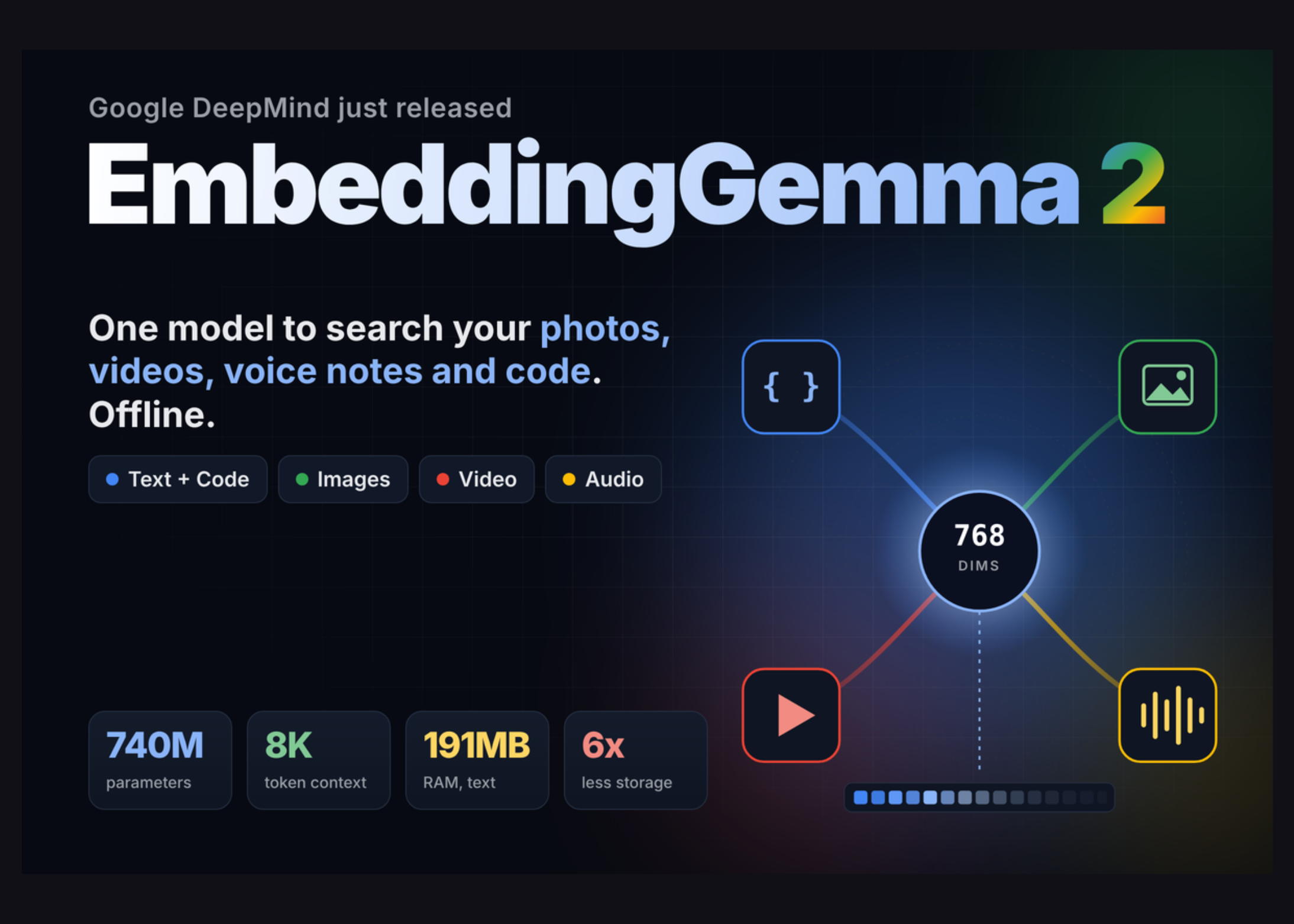
According to a MarkTechPost report dated October 6, 2026, Google DeepMind released EmbeddingGemma 2, an Apache 2.0-licensed open-weights multimodal embedding model with 740 million parameters and 8K context, mapping text, code, images, video, and audio into a single 768-dimensional space. The 270-million-parameter text backbone can be loaded separately.
What changed
According to a MarkTechPost report dated October 6, 2026, Google DeepMind released EmbeddingGemma 2, an open-weights multimodal embedding model built on the Gemma 4 architecture under an Apache 2.0 license. It uses modular encoders to map different modalities into the same 768-dimensional vector space: the text and code backbone is about 270 million parameters (130 million transformer plus 140 million embedder), with an optional 170-million-parameter vision encoder and an optional 300-million-parameter audio encoder, for roughly 740 million parameters when fully loaded, so developers can load only the parts they need. The context window is 8192 tokens, which the report says is four times that of the first generation and holds roughly 29 images, 58 video frames, or 5.5 minutes of audio. per the model card, MTEB Code v1 rose from 68.76 in the previous generation to 78.68, MTEB multilingual v2 went from 61.15 to 61.36, and new metrics were added including 64.64 on MIEB lite image, 59.01 total on MMEB v2, and 49.39 on MAEB audio. The report says the weights are live on Hugging Face and Kaggle, with runtime options including Ollama, llama.cpp GGUF, LiteRT, sentence-transformers v6.1.0+, vLLM, SGLang, MLX, LM Studio, and MediaPipe; vector storage is supported by Qdrant and fine-tuning by Unsloth; MRL supports truncating vectors to 512, 256, or 128 dimensions.
What it means for developers
For developers, the key change in this release is not the parameter count but that one vector space covers code and audio at the same time, and that the text backbone can be loaded alone. This directly changes three kinds of selection decisions. First, the retrieval layer of multimodal RAG previously often needed two embedding models for text and images, two indexes, and score normalization logic; the report says query vectors generated by a text-only configuration can match document vectors generated by the full model, and if reproducible this means an index can be built first with the 270-million-parameter backbone and vision or audio encoders added later without rebuilding the store. Second, the size of the code retrieval benchmark gain (reported as about 9.92 points, roughly 14%) puts it on the candidate list for semantic search over codebases, but that is a vendor model card number, not performance on your own repository. Third, it trades off differently against Alibaba's Qwen3-VL-Embedding-2B: the latter is reported to self-report 73.2 on its own MMEB v2 testing, has about 2.7 times the parameter count, and does not support audio, while EmbeddingGemma 2 emphasizes 8K context, on-device memory, and audio support. Note that open weights are not the same as an unrestricted open source license: Apache 2.0 is a permissive license, but the training data provenance in the model report and downstream compliance requirements still need to be checked independently. In addition, KimiSeek's current model catalog contains no entry named EmbeddingGemma 2, so this version is not currently listed on KimiSeek; the availability mentioned in the report refers to external channels such as Hugging Face, Kaggle, and Ollama, and any future API offering should be confirmed on its provider's page.
Integration and evaluation
The following are recommendations and conditional analysis, not reported facts. Recommendation one: first determine whether cross-modal retrieval is needed. If you only have Chinese text and code and already use a mature text embedding model, treat EmbeddingGemma 2 as an A/B candidate rather than an immediate replacement; run a recall experiment first with the same set of your own queries and documents, using Recall@10 and nDCG@10 as metrics rather than looking only at MTEB scores. If the workload genuinely includes mixed text and images or voice memo retrieval, it is worth validating the shared vector space assumption first: build a store with the 270-million text backbone, then embed the same batch of text-and-image documents with the full model, measure cross-configuration similarity consistency, and if relevance ranking drifts noticeably, build separate indexes for different configurations. Recommendation two: the trade-off between dimensions and storage. The report says MTEB multilingual drops only slightly from 61.36 to 60.41 at 256 dimensions, while at 128 dimensions MMEB falls to 45.65 and the official recommendation is that 128 dimensions is mainly for text only. If your bottleneck is vector store cost and the use case is text only, you can first switch to 256 dimensions to validate; if images or video retrieval are involved, keep 768 dimensions, compare recall gaps between 256 and 768 dimensions on your own data, and set an acceptable recall loss threshold before deciding. Recommendation three: deployment stack lock-in risk. There are many runnable stacks, so choose based on whether your target is server-side or on-device, and write the vector dimensions, prompt templates (the reported SearchQuery and Document prompt names), and quantization method into the configuration together, running a fixed regression set once before and once after quantization to compare recall differences. Be sure to evaluate with your own enterprise data rather than public leaderboards, because multilingual quality is roughly flat in the report, with gains concentrated in code and the newly added modalities.
Limits and open questions
The benchmarks, memory usage, and latency figures above all come from the Google model card or the research team's own statements; they are vendor reports and have not been independently reproduced by third parties. The on-device 191MB and 567MB are active memory after quantization on a specific device (Pixel 11 Pro) and cannot be extrapolated directly to other hardware. The report does not disclose details of the training data composition or language distribution, so actual performance in Chinese scenarios needs to be verified independently. In the cross-model comparison, Qwen3-VL-Embedding-2B's 73.2 is its own self-reported MMEB v2 figure, and partial comparisons and scores from different leaderboards cannot be compared directly. In addition, the EmbeddingGemma 2 version does not currently appear in KimiSeek's model catalog, so this article does not treat it as a model available on KimiSeek; the reported weight availability, Ollama pulls, and runtime support all refer to external channel vendor or community releases, and their availability and any future pricing should be confirmed on the corresponding platform's official pages. The report mentions that ML Kit support for Android will arrive within a few weeks; that is a plan rather than an accomplished fact and should not be used for scheduling.
Illustrations from the original report