GLM 5.3 Arrives on Amazon Bedrock: 753B MoE Served via Managed API, Explicit Prompt Caching and Cross-Region Inference in Focus
According to an AWS official blog post dated October 5, 2026, Z.ai's GLM 5.3 is now available on Amazon Bedrock to eligible enterprise customers, callable via OpenAI-compatible Responses/Chat Completions and Bedrock Invoke/Converse, with implicit and explicit prompt caching, US and Global cross-region inference configurations, and a documented path for invoking it with the open-source penetration-testing agent Strix.
What changed
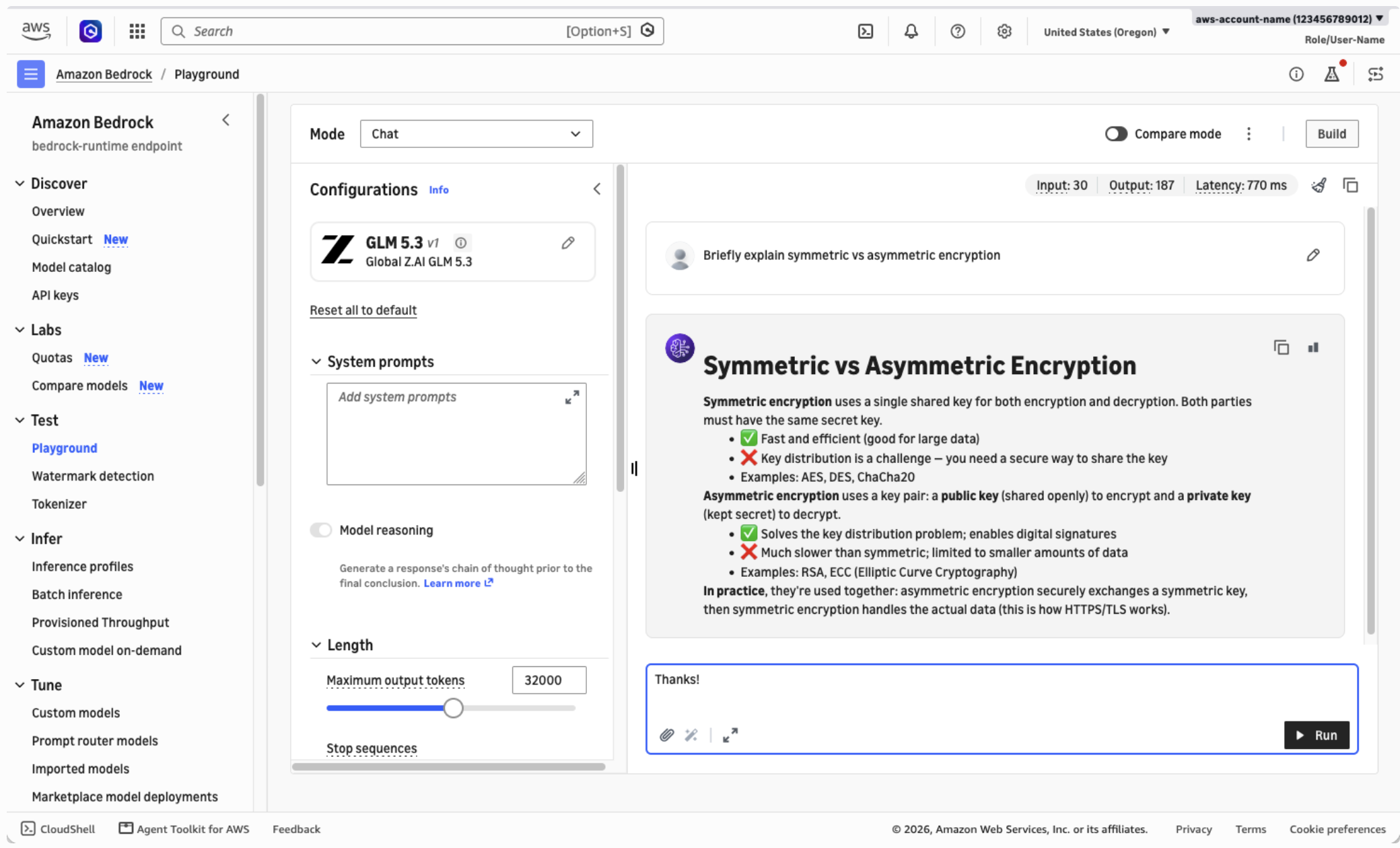
According to an AWS official blog post dated October 5, 2026, Z.ai's GLM 5.3 is now live on Amazon Bedrock and open to eligible enterprise customers. The post states that, per information published on the Hugging Face Hub, GLM 5.3 is a 753B-parameter mixture-of-experts (MoE) model optimized for coding and long-horizon agentic tasks; Z.ai reports it performs strongly on security tasks, scoring 84.5 on the CyberGym benchmark at release. Compared with GLM 5, which landed on Bedrock earlier this year, the post lists three changes: Z.ai says it is competitive on coding benchmarks including DeepSWE, Terminal Bench 3.0 and FrontierSWE, and improved 50% over GLM 5.2 on an internal coding benchmark, but no direct comparison to GLM 5 is given because the benchmarks themselves have been updated since GLM 5.1; security capability is described as "emergent"; and the Bedrock integration is more complete. On access, the model can be called through the bedrock-runtime endpoint via OpenAI-compatible Responses and Chat Completions APIs, and also supports Bedrock's Invoke and Converse; AWS recommends new applications prefer the OpenAI-compatible API and prefer short-term credentials over long-lived API keys. The model is offered through two cross-region inference profiles, us.zai.glm-5.3 and global.zai.glm-5.3, with three service tiers: Flex, Priority and Standard.
What it means for developers
For developers evaluating hosted paths for Chinese models, the substantive change here is not that the model is stronger, but that the calling surface and cost-control levers have been filled in. First, Bedrock offering both OpenAI-compatible interfaces and native Invoke/Converse means existing OpenAI SDK code changes center on base_url, authentication (exchanging AWS CLI credentials for a short-term token via aws-bedrock-token-generator) and the model identifier, rather than rewriting the calling layer; for teams that already maintain several OpenAI-compatible adapters, migration cost lies mainly in credentials and routing, not business logic. Second, explicit prompt caching is flagged by AWS as recommended, and for agentic workloads that resend a system prompt, tool definitions or repository files every turn, it bears directly on input token cost and time to first token, which makes cache hit rate an observable engineering metric. Third, cross-region inference profiles decouple where a request is sent from where it is actually processed, so enterprise customers need to revisit data residency and compliance positions rather than assume requests execute in place. Fourth, Strix documentation currently uses GLM 5.3 as its default model and can point at Bedrock, which keeps inference for highly sensitive workloads such as security testing inside the customer's own AWS account controls; that is a meaningful option for security teams, but it involves authorization scope and compliance judgment and should not be equated with out-of-the-box readiness. Note that all of the above capability descriptions come from a single AWS blog post and Z.ai's self-reported benchmarks, with no independent reproduction yet.
Integration and evaluation
Evaluate under the following conditional rules; these are judgments based on the source, not confirmed conclusions. First, whether to switch to the OpenAI-compatible interface: if an existing application is already based on the OpenAI SDK and needs the full explicit caching feature set, AWS says the OpenAI-compatible Responses API should be preferred; if existing code is deeply tied to Bedrock Converse or needs to share a calling layer with other Bedrock models, keeping the native interface means fewer changes. The precondition is that the account holds bedrock:InvokeModel, bedrock:InvokeModelWithResponseStream and bedrock:CallWithBearerToken permissions. A measurable test is to run two turns of conversation under the same long system prompt, check whether input_tokens_details.cached_tokens in the response is non-zero, and compare billed input tokens and time to first token between the two. Second, whether to enable explicit caching: if the workload resends large static context each turn (system prompt, tool definitions, repository snippets), the source suggests switching to the explicit mode of prompt_cache_options and placing a prompt_cache_breakpoint; if context is short or changes frequently, implicit caching suffices and does not justify the marker maintenance cost. The precondition is that each breakpoint needs at least 1,024 tokens to qualify for caching, so marking short prompts does nothing. Measurable criteria are the cached-token share and the reduction in end-to-end latency under the same load, plus confirmation that breakpoint splits do not break semantic boundaries. Third, which cross-region profile to choose: teams serving US users or already subject to us-region compliance requirements should evaluate us.zai.glm-5.3, while teams needing broader coverage should evaluate global.zai.glm-5.3, choosing on data residency requirements and measured latency rather than defaulting to "global". Measurable criteria are P50/P95 latency from the target source region and a written compliance review conclusion on the processing region. Fourth, service tier: evaluate Flex to optimize cost for insensitive workloads such as batch or offline analysis, evaluate Priority for latency-sensitive requests such as interactive coding assistants, and treat Standard as the default baseline. The precondition is that tier choice changes unit price, so check current billing in the console. In all cases, start with a small-scale comparison using your own codebase and real agent trajectories rather than swapping out a production default model directly.
Limits and open questions
GLM 5.3 does not currently appear in KimiSeek's live catalog; the Bedrock availability, model identifiers and billing descriptions in this article come from AWS and Z.ai and do not represent supply on KimiSeek. KimiSeek's catalog separately lists entries such as GLM-5.3, GLM-5.3 Flash and GLM-5.2, which are different versions or different supply channels and cannot be used to infer that the Bedrock version described here is live on KimiSeek. The performance claims in the source, including CyberGym 84.5, the 50% improvement over GLM 5.2 on an internal coding benchmark, and the "competitive" wording for DeepSWE, Terminal Bench 3.0 and FrontierSWE, are all Z.ai self-reports or AWS relayings of them, with no independent reproduction; the benchmark versions have also been updated since GLM 5.1, so cross-model comparisons warrant caution. AWS states explicitly that GLM 5.3 is for "eligible enterprise customers"; whether ordinary accounts can enable it directly or whether all regions are available is not explained in the source. The original text also notes that LiteLLM at the time could not yet resolve bedrock/global.zai.glm-5.3 and required explicitly specifying the Converse route and inference profile ARN; this was a known limitation at the time and whether it has since been fixed is unknown. The statement that Strix uses GLM 5.3 as its default model comes from documentation described as accurate "as of the time of writing" and may have changed. Prices and tier unit rates change over time, so refer to the live pricing pages of AWS and KimiSeek. The security testing example applies only to applications you own or have written authorization for, and the source content is truncated at the AWS Continuum paragraph.
Illustrations from the original report