Kyutai Releases CADRE Video Autoencoder: World Model Action Latency Cut Below 230 ms, Weights Barred for Commercial Use
According to an October 23, 2026 report by MarkTechPost, Kyutai released CADRE, a causal diffusion representation autoencoder; the paper claims its world model runs at 20 fps on a single H100 and responds within 185 to 216 milliseconds. The code is MIT, but the Hugging Face weights are CC BY-NC 4.0, excluding commercial use, and the source also lists shortcomings such as robotic manipulation action following.
What changed
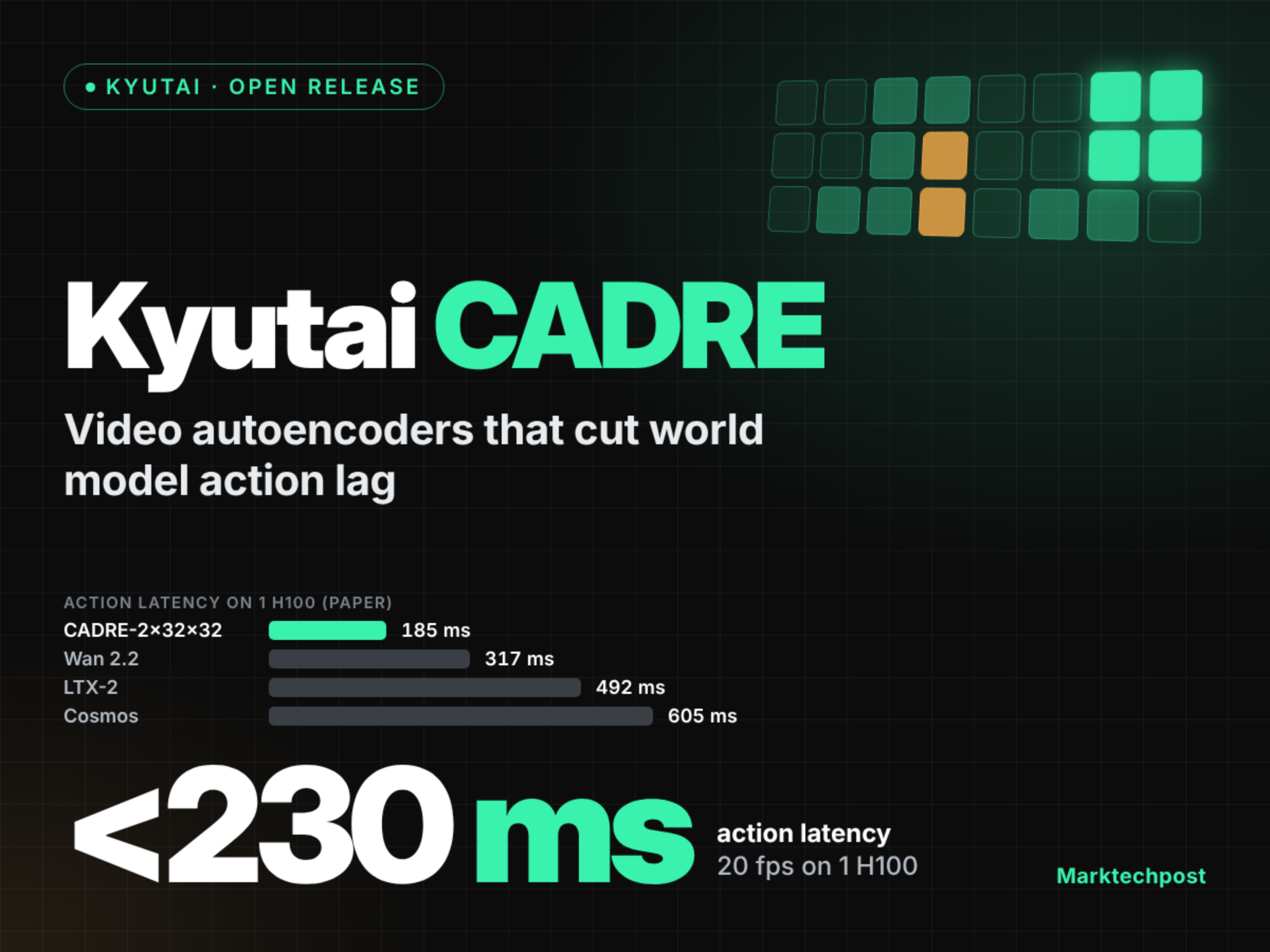
According to an October 23, 2026 report by MarkTechPost, Kyutai released CADRE, a set of video autoencoders for action-conditioned interactive world models. Its core problem framing is that most world models reuse autoencoders from text-to-video, packing multiple frames into one latent variable, which forces each action to wait. The compression ratio is written as τ×s×s, where τ is the number of frames per latent variable and s is the spatial factor; the paper gives the latency as τ/f plus generation and decoding time. The CADRE encoder reuses the MIRA scheme: a frozen DINOv3 extracts per-patch features, which are then compressed by a trained 3D convolution into a 64-channel latent variable, with the seven members differing only in this bottleneck. The decoder is a causal diffusion Transformer with 24 blocks, processed block by block in a streaming manner, and learns 1-step or 2-step decoding through progressive self-distillation. The source says the autoencoder was trained on roughly 76,000 hours from 23 public video sources, covering web, robotics, driving and game videos. The reported data show that CADRE-2×32×32 responds in 185 milliseconds and sustains 23.4 fps on a single H100 with bf16 and batch 1, while CADRE-2×16×16 takes 216 milliseconds; as a comparison, the Wan 2.2 autoencoder takes 317 milliseconds, LTX-2 takes 492 milliseconds, and Cosmos takes 605 milliseconds, while DC-AE is faster but processes frame by frame. These numbers and comparisons are all self-reported by Kyutai and have not been independently reproduced.
What it means for developers
The practical impact for developers centers on three levels. The first is the change in how the latency budget is composed: CADRE compresses block waiting from several hundred milliseconds in the τ=8 scenario down to the τ=2 order of magnitude, which means that under the constraints of 20 fps and the roughly 230-millisecond threshold of human perceptibility, budget previously consumed by block latency can be returned to the controller or rendering stage, making it suitable for interactive simulation and robot replay evaluation that are sensitive to action following. The second is that the compression ratio becomes an explicitly tunable variable: the seven autoencoders differ only in one bottleneck, and the source says that in 48 comparisons, 42 were comparable in speed and superior in quality, so developers can treat the spatial factor and temporal factor as independent knobs rather than accepting the fixed compression of a single video VAE. The third is licensing and deployment constraints: the code is MIT, but the weights are CC BY-NC 4.0, and the source explicitly states that commercial use is excluded, so commercial products can only borrow the method or train their own, not directly distribute the weights. The source also notes that each world model covers a single environment at 288×512, and the transferability of a general model remains to be verified; long latent variables leave visible seams between blocks, with boundaries exceeding by 1.6 to 1.8 at τ=8. These are all research conclusions reported by the source.
Integration and evaluation
The following is conditional analysis based on the source information, not verified fact. First decision: if your workload involves static or slow camera scenes, you can prioritize members with greater temporal compression, such as configurations with higher τ and coarser spatial factors; if the camera moves quickly, you should shift to configurations with fewer frames and larger spatial factors, because the source says moving cameras prefer the latter, and in driving scenes CADRE's FVD is clearly better than Wan 2.2. The premise is that your evaluation set contains camera motion patterns consistent with the deployment scenario; the measurable criterion is whether the action-following metric ARR or driving FVD on the same held-out set reaches your set threshold, rather than just looking at reconstruction PSNR. Second decision: if your target is robotic manipulation tasks, do not assume CADRE is comprehensively superior, because the source says that in robotic manipulation CADRE-2×32×32 has an ARR of 0.45, while Wan 2.2 is 0.85, and Cosmos also has lower FVD. In this case, you should first compare candidate members with short rollouts on local robotic manipulation data, with the criterion being that ARR does not drop relative to the baseline and latency remains within your budget; if it fails, keep other autoencoders or a hybrid approach. For the evaluation steps, it is recommended to reproduce the process described by the source: first feed 2 seconds of real video, then generate about 4.8 seconds, while using a frozen inverse dynamics probe to compute ARR, and check whether visible seams appear at block boundaries, since seams are more obvious at larger τ. If you plan to train your own world model, note that the source's 1.2-billion-parameter causal diffusion Transformer is trained separately on each autoencoder, so changing the autoencoder means retraining the downstream model, not just replacing the encoder. Before commercial deployment, you should verify the weight license terms yourself, and if necessary switch to an autoencoder with a permissive license such as Apache 2.0.
Limits and open questions
The latency, fps, FVD, ARR, PSNR and comparison conclusions in the source are all self-reported by Kyutai; this article has not independently reproduced them and has not conducted any testing. Quantized versions are not disclosed; the source only provides single-H100 data for bf16 and batch 1, so actual deployment memory usage, multi-batch throughput and post-quantization accuracy loss are all unknown. The source explicitly states that the weights are CC BY-NC 4.0, excluding commercial use, while the code is MIT; the two licenses differ and should not be conflated. The source also states that each world model covers only one environment, and whether the conclusions can transfer to a general model remains to be answered, and that CADRE is weaker than Wan 2.2 in robotic manipulation action following. It should be noted that this CADRE version does not currently appear in KimiSeek's live catalog; the Hugging Face download and online demo mentioned by the source are Kyutai's own channels and unrelated to this site; if it is introduced in the future or pricing changes, the site's pricing page should be taken as authoritative.