Meta Opens Muse Spark Open Weights: 816B MoE Runs Locally on Two Mac Studios, Coding Benchmarks Trail GLM 5.3 max and Kimi K3 max
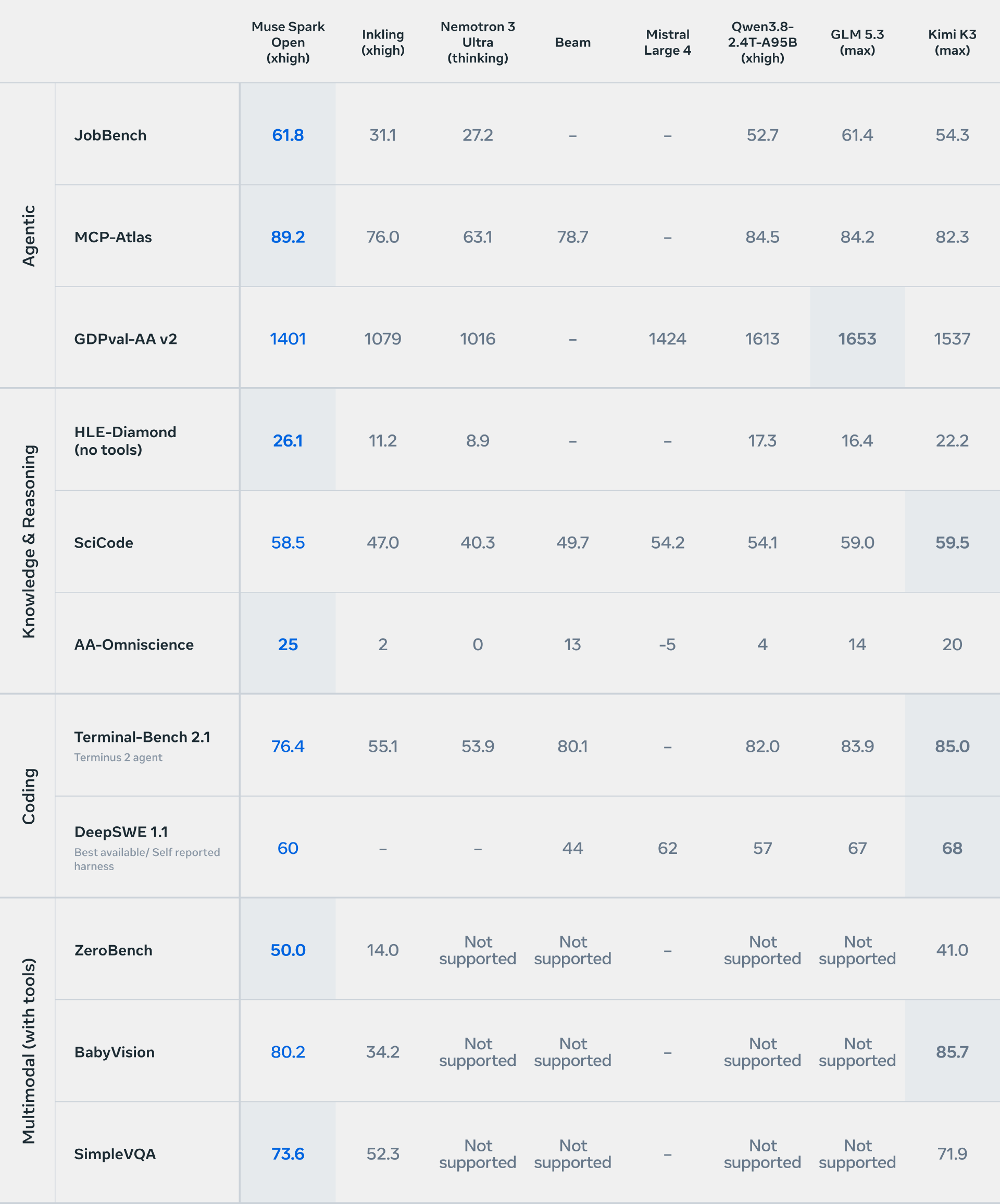
According to an InfoQ report on October 18, 2026, Meta opened the Muse Spark Open weights on October 15: a sparse MoE with 816 billion total parameters and roughly 42 billion active parameters, supporting a context of about 1.05 million tokens and text, image, audio, and video input, deployable on two M5 Ultra Mac Studios via MLX. The report says its Terminal-Bench 2.1 and DeepSWE 1.1 scores trail GLM 5.3 max and Kimi K3 max, and that it is licensed under the Muse Model License.
What changed
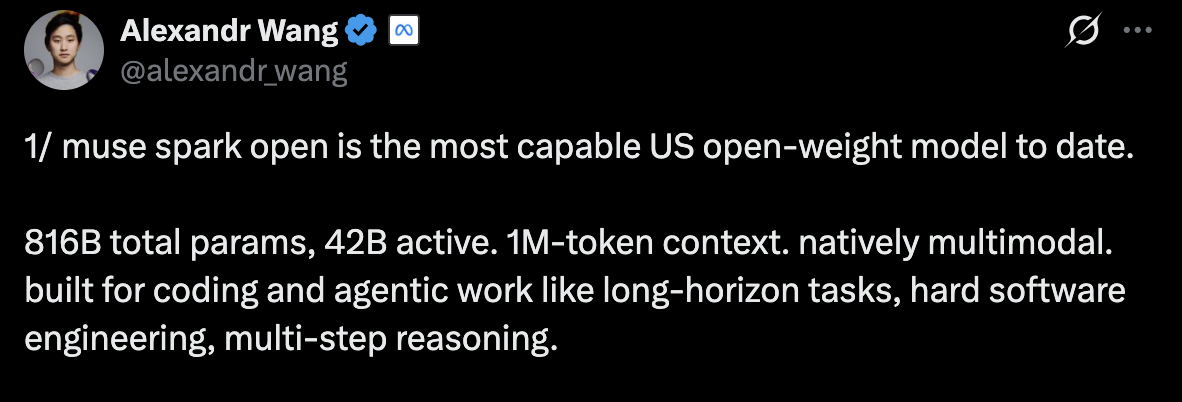
According to an InfoQ report on October 18, 2026, Meta announced on October 15 local time that it was opening the Muse Spark Open model weights, positioned as a large agent model for software engineering, long-horizon task execution, and multi-step reasoning, which Meta calls its most capable U.S. open-weight model to date. The model uses a sparse mixture-of-experts architecture with 816 billion total parameters, about 42 billion activated per token, supports a 1,048,576-token context, accepts text, image, audio, and video input, and outputs text. The report says Meta's published evaluation results are JobBench 61.8, MCP-Atlas 89.2, and OSWorld Verified 80.4; for coding, Terminal-Bench 2.1 is 76.4 and DeepSWE 1.1 is 60, and it notes these last two trail the domestic open models GLM 5.3 max and Kimi K3 max. The local deployment approach uses MLX on two Mac Studios equipped with M5 Ultra; Apple's published four-machine distributed test generated over 36 tokens per second; official documentation shows BF16 weights at about 1.65 TB and NVFP4 at about 537 GB. Licensing uses the Muse Model License, which requires displaying a specified attribution mark and imposes notification and separate written agreement requirements on licensees whose combined annual revenue exceeds $20 million and who provide the model as a model-as-a-service, while listing exceptions for internal use and research.
What it means for developers
For developers, the direct implication of this release is not "one more downloadable set of weights," but that it splits the decision variables of large-model deployment from parameter count into three things: weight storage, per-token compute, and cross-device communication. The distinction in the report between 816 billion total parameters and about 42 billion active parameters is key—the former determines whether it fits, the latter whether it computes. By the report's figures, BF16 at about 1.65 TB requires 8 B300s, NVFP4 at about 537 GB requires 4 B300s, and Apple's test used NVFP4 rather than BF16; this means quantization and multi-machine parallelism are preconditions for desktop deployment to hold, and neither alone explains the result. At the same time, the two Macs with 512 GB each in the report do not merge into one machine with about 1 TB of unified addressing; cross-machine operation needs RDMA and MLX collective communication, so scaling gains will be constrained by communication. For teams already using GLM 5.3 max or Kimi K3 max for coding and long-horizon tasks, this comparison offers a candidate for replacement or complement, but the report also notes that Muse Spark Open does not lead on Terminal-Bench 2.1 and DeepSWE 1.1, and that the official demos (Ice Cubes iOS development, DaVinci Resolve frame-by-frame selection) are vendor showcases and cannot be extrapolated to mean similar tasks can all run unattended.
Integration and evaluation
The following are suggestions and conditional analysis based on the report, not verified facts. First, if your workload is long-horizon tool calling and you need data to stay on-premises, you could first evaluate Muse Spark Open's task completion rate via a hosted API, then decide whether to self-host; the report lists ecosystem partners including Baseten, Fireworks AI, Groq, Modal, Nebius, Together AI, and OpenRouter, and deployment tooling covering SGLang, vLLM, TensorRT-LLM, llama.cpp, and MLX. The condition for choosing self-hosting is whether you already have NVFP4-capable accelerators or two large-memory Macs; the metric to assess is the difference in end-to-end success rate and per-task latency between the hosted API and local inference on the same set of real tool-calling tasks. Second, when choosing between NVFP4 and BF16, the report's premise is NVFP4 at about 537 GB and BF16 at about 1.65 TB; if your VRAM or unified memory is insufficient, you must go with NVFP4, at the cost of needing to verify long-context stability after quantization, with the metric being the drop versus BF16 in information recall accuracy and tool-call success rate near the 1.05 million-token length. Third, if you provide model-as-a-service to third parties and your combined annual revenue may exceed the reported $20 million threshold, you should confirm the applicability of the notification and separate written agreement before putting this model or a derivative into business use, and check whether exceptions such as internal use, research, and your own non-model-as-a-service products cover your scenario; this is a licensing question requiring legal rather than engineering judgment. Fourth, if you plan to scale with multiple Macs, do not estimate usable capacity by summing machine memory; the report notes cross-machine communication is an independent bottleneck, and the metric to assess is whether the per-token generation speed increase from two to four machines scales linearly with machine count.
Limits and open questions
To be clear: Muse Spark Open and its 816B-A42B version do not currently appear in this site's live model catalog, and this site has no entry for the model, so the hosted and API availability mentioned above refers to the vendor and the third-party service partners it lists and does not mean this site can call it. All benchmark scores, weight sizes, hardware configurations, and license terms in the report come from Meta's official statements and InfoQ's relay, and this article has not independently reproduced or tested them; there are reservations in the community about the credibility of leaderboard results, as cited in the report. Open weights are not the same as no commercial conditions; the Muse Model License's attribution mark and revenue threshold terms must be confirmed clause by clause against the original text, and the report explicitly states that these terms have exceptions for internal use and research, so they should not be simplified into "all high-revenue companies must pay." The report's claims about operator-level speedups of 1.03–3.95x and about roughly 3% end-to-end speedup on AMD MI350 are two different measures, operator-level versus end-to-end, and cannot be extrapolated into an overall inference speed improvement. Official demos and quoted individuals are third-party statements and cannot be taken as evidence of unattended capability. In addition, the model's support for video and audio input means understanding only, not native generation capability; local deployment reduces the need for data to leave the premises, but does not automatically acquire the safety checks and access controls of a hosted service, and an agent given excessive file and command permissions may still cause unintended modifications or data loss.
Illustrations from the original report