NVIDIA releases Nemotron 3.5 Bolt E4B: a local agent aimed at 4GB VRAM, behind Qwen3.5-4B on tool-calling benchmarks
According to a MarkTechPost report dated October 23, 2026, NVIDIA released the open-weight model Nemotron 3.5 Bolt E4B, post-trained from Gemma 4 E4B with reinforcement learning only. It has 8B total parameters, 4B effective parameters and a 64K context, and targets local voice assistants, game NPCs and robots. NVIDIA's own tests put it first on 15 of 21 benchmarks, but its Tau2-Bench score of 55.1 trails Qwen3.5-4B's 75.1.
What changed
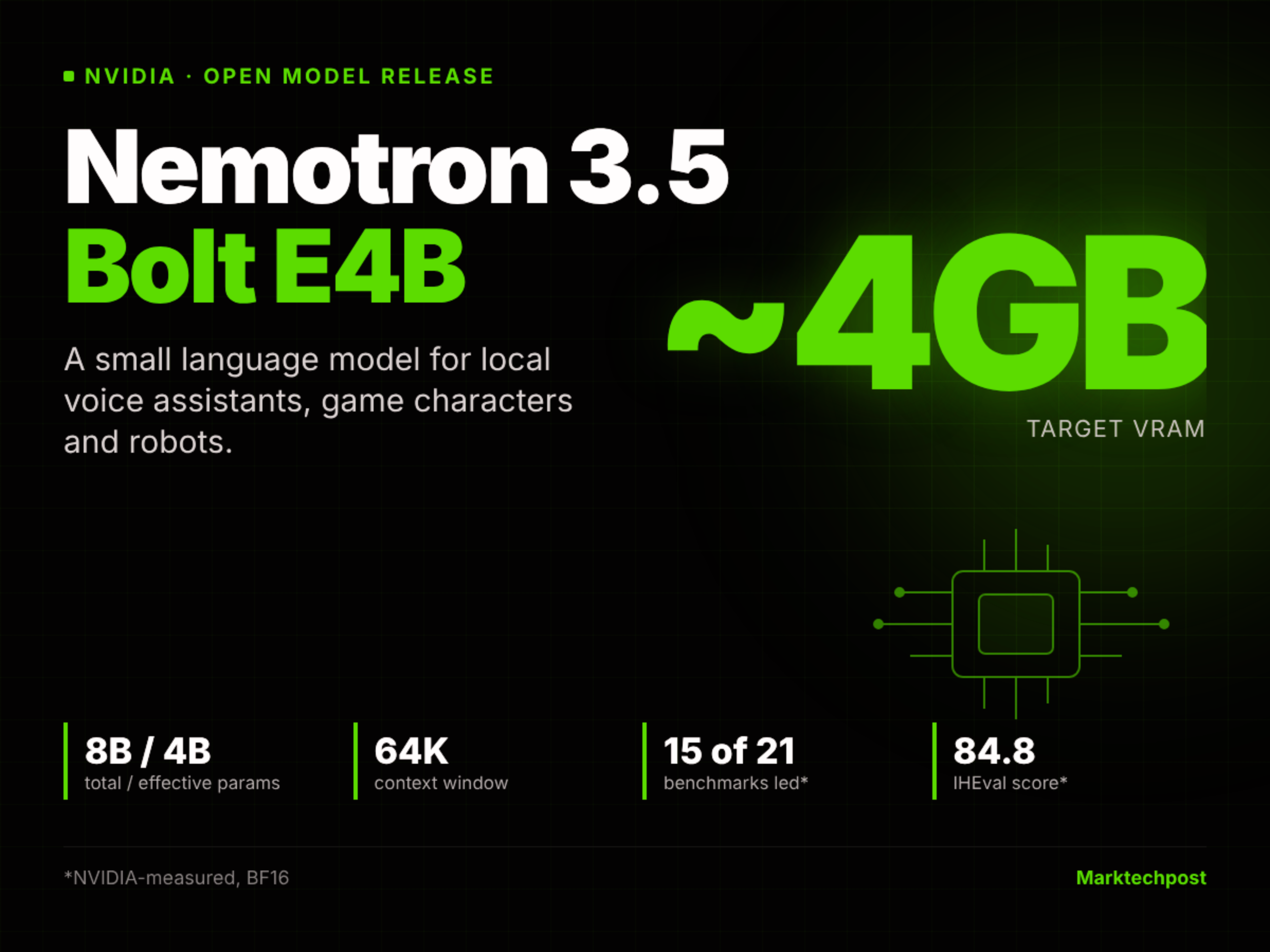
The MarkTechPost report dated October 23, 2026 says NVIDIA released Nemotron 3.5 Bolt E4B, starting from Google's Gemma 4 E4B and skipping supervised fine-tuning entirely, post-training only with RLVR and RLHF via NeMo-RL and NeMo-Gym. Training mixed reasoning and non-reasoning modes, running each sample through both; the ratio of non-reasoning to reasoning samples in a batch was kept at 2:1, and a length penalty in the GenRM environment discouraged longer answers. The dataset and recipe were released. The model has 8B total parameters, 4B effective parameters and a 64K context, supports multi-turn and asynchronous tool-calling guidance, and has a conversational_mode flag that produces short replies suited to voice; reasoning and the runtime thinking budget are configurable. The report describes it as the third-generation small model for NVIDIA ACE game characters and shows a Reachy Mini robot running on a Jetson Orin Nano 8GB, with Cosmos 3 Edge handling vision and Bolt handling voice replies and tool calls. On deployment, NVIDIA quantized the BF16 checkpoint to Q4_K_M with importance-matrix calibration using roughly 1 million tokens of RL rollouts, and shipped a DFlash drafter for speculative decoding: the report says Bolt reaches 272.6 tokens/s on an RTX 5070, versus 225.9 tokens/s for Gemma 4 E4B with its MTP drafter. Hardware measurements (Q4_K_M, llama.cpp, batch size 1, 3K input and 50 output tokens) show the RTX 5070 using 3.5GB of VRAM with 548 ms to first token and 133.4 tokens/s; Jetson AGX Orin 32GB using 4.2GB with 3687 ms and 24.0 tokens/s; and Jetson Orin Nano 8GB using 4.2GB with 5785 ms and 15.5 tokens/s. The report stresses that "4GB" is a target VRAM range, not a file size: the Q4_K_M GGUF on Hugging Face is 6.18GB. The weights are released under the OpenMDW-1.1 license, with the data and recipe public. The model is available on Hugging Face, Ollama, LM Studio, Unsloth and Jetson AI Lab, is also offered as NVIDIA NIM and the In-Game Inferencing SDK, and there is a free API on NVIDIA's official hosted platform. On benchmarks, all reported scores are BF16 and measured by NVIDIA in its own NeMo-Gym framework: it is highest on 15 of 21, with IHEval 84.8 (Gemma 4 E4B 67.0, Qwen3.5-4B 60.6). Tau2-Bench is 55.1, behind Qwen3.5-4B's 75.1, RULER 64K is 87.0, also below Qwen3.5-4B's 95.1, and LongBench v2 (50.5 vs 59.9) and BFCL-v3 (68.5 vs 70.9) are likewise led by Qwen3.5-4B, while Gemma 4 E4B edges ahead on EQ-Bench v3 at 41.1 vs 39.4. The report also relays NVIDIA's claim that the average score is about 40% higher than Nemotron 3 Nano 4B and that reasoning-enabled comparisons use up to 80% fewer output tokens.
What it means for developers
The direct impact for developers comes down to two things: VRAM budget and task division. The VRAM figures in the report are bare-model inference only and exclude speech recognition, speech synthesis or vision models; if you configure to the Jetson Orin Nano 8GB demo in the report, the model alone takes 4.2GB, and what remains determines how large a perception model you can add, whether you can raise image resolution, and whether you need to move to a 16GB-plus device. The gap in time to first token matters just as much: 548 ms on an RTX 5070 and 5785 ms on an Orin Nano are entirely different interactive experiences, the latter closer to turn-based than natural interjection. The skill distribution means it is better treated as a specialized component than a general small model. Of 21 benchmarks across 5 capability areas, NVIDIA claims a lead on only 15, and the losses cluster in long context and the agent toolchain: Tau2-Bench, RULER 64K, LongBench v2 and BFCL-v3 all lose to Qwen3.5-4B. Conversely, instruction-following scores like IHEval 84.8 are a strength, and conversational_mode shows the design intent leans toward short, fast, directly speakable replies. Overall, it is a candidate for "conversation plus light tool calling", not a default choice for complex multi-turn planning or very long context retrieval. Differences in measurement basis need to be factored in. All those scores were measured by the vendor in its own test framework and may differ from third-party reproduction; the report separately notes that Scale Labs gives 56.03% on MultiChallenge, above NVIDIA's self-reported 53.1. Two sets of numbers coexisting in one report show that no single score should be treated as conclusive when choosing a model, especially when your business distribution differs from the benchmark distribution.
Integration and evaluation
The following are conditional recommendations and analyses based on the report, not verified conclusions. Decision 1: choose the quantization and deployment form according to the target device's remaining VRAM. If the device is an 8GB-class Jetson or a 12GB GPU and you need to run speech and vision models at the same time, validate the Q4_K_M plus llama.cpp path first: the reported 4.2GB footprint and 6.18GB file size show the weights file itself does not fit a "4GB" budget, and the quantized runtime form is the usable form. The test criteria are concrete: at your own input length (the report used 3K input and 50 output tokens), measure time to first token and tokens/s, and confirm there is still headroom after adding perception models; if time to first token exceeds what your interaction design accepts, switch to a smaller or more aggressive quantization level rather than continuing to tune prompts. Decision 2: decide whether Bolt belongs in the loop based on whether the workload is mainly tool calling. If the product is voice-assistant-style short conversations with a few tool calls, its conversational_mode and 64K context are worth testing; if the core pipeline is long multi-turn tool trajectories with state, the reported Tau2-Bench gap of 55.1 vs 75.1 suggests establishing a baseline with Qwen3.5-4B first. The test criterion is to turn your own multi-turn tool-calling trajectories into a fixed evaluation set and compare task completion rate and average number of calls under the same function definitions, rather than only looking at whether single-turn answers read smoothly. Decision 3: treat the runtime thinking budget as a parameter to calibrate, not a switch. The report says the model supports configurable reasoning and a runtime thinking budget, and claims up to 80% fewer output tokens in reasoning-enabled comparisons (a vendor claim). That means the same weights follow two different latency and quality curves with reasoning on and off. The approach is to set a latency budget for the voice pipeline, pick one of the two within that budget, and use output token count and time to first chunk as measurable indicators to check whether the token-saving claim holds on your own task distribution. Decision 4: check the license separately. The report says the weights are released under OpenMDW-1.1 while the base model Gemma 4 E4B is Apache 2.0; the terms differ. Before putting the weights into a product, read the license text directly to confirm distribution, attribution and commercial conditions rather than inferring permissions from a label like "open weights".
Limits and open questions
Nemotron 3.5 Bolt E4B as described here is not currently listed on KimiSeek; there is no corresponding entry in the site's model list. The free API mentioned in the report refers to the model's availability on NVIDIA's official hosted platform and has nothing to do with this site; actual availability and terms are subject to the vendor's documentation. Known boundaries include: all benchmark scores in the report are BF16 and measured by NVIDIA in its own NeMo-Gym framework, not independently reproduced; the claims of an average score about 40% above Nemotron 3 Nano 4B and up to 80% fewer output tokens with reasoning enabled are both vendor-reported. The speed comparison also has a different basis: 272.6 vs 225.9 tokens/s are Bolt with a DFlash drafter and Gemma 4 E4B with an MTP drafter on an RTX 5070, which differs from the 133.4 tokens/s basis in the hardware table, and the two cannot be used interchangeably. On MultiChallenge, NVIDIA self-reports 53.1, and an X post relayed in the report says Scale Labs gives 56.03%; the two numbers need to be attributed separately. On licensing, Bolt is released under OpenMDW-1.1 while the base Gemma 4 E4B is Apache 2.0, and open weights do not equal equivalent commercial terms. Hardware data covers only four RTX and Jetson configurations; there is no data for other platforms. On input modalities, according to the comparison table in the report, the Bolt model card lists text input, while the NIM form also accepts images and audio; the actually available modalities and limits still need to be confirmed against official documentation, and the report gives no evaluation data for those modalities.