OlmoEarth v1.3 Released: 128-Dimensional Satellite Embeddings, Global Precomputed Archive, and a No-Login Explorer
According to an Allen AI blog post published on October 22, 2026, OlmoEarth v1.3 is a satellite embedding model that reads annual time series from Sentinel-1, Sentinel-2 and Landsat, producing a 128-dimensional vector for every 10-meter pixel, with the first 64 dimensions usable on their own. The team claims its 128-dimensional embeddings scored highest on 20 of 27 evaluations, and is releasing global precomputed embeddings, weights, pretraining data and code under the OlmoEarth Artifact License.
What changed
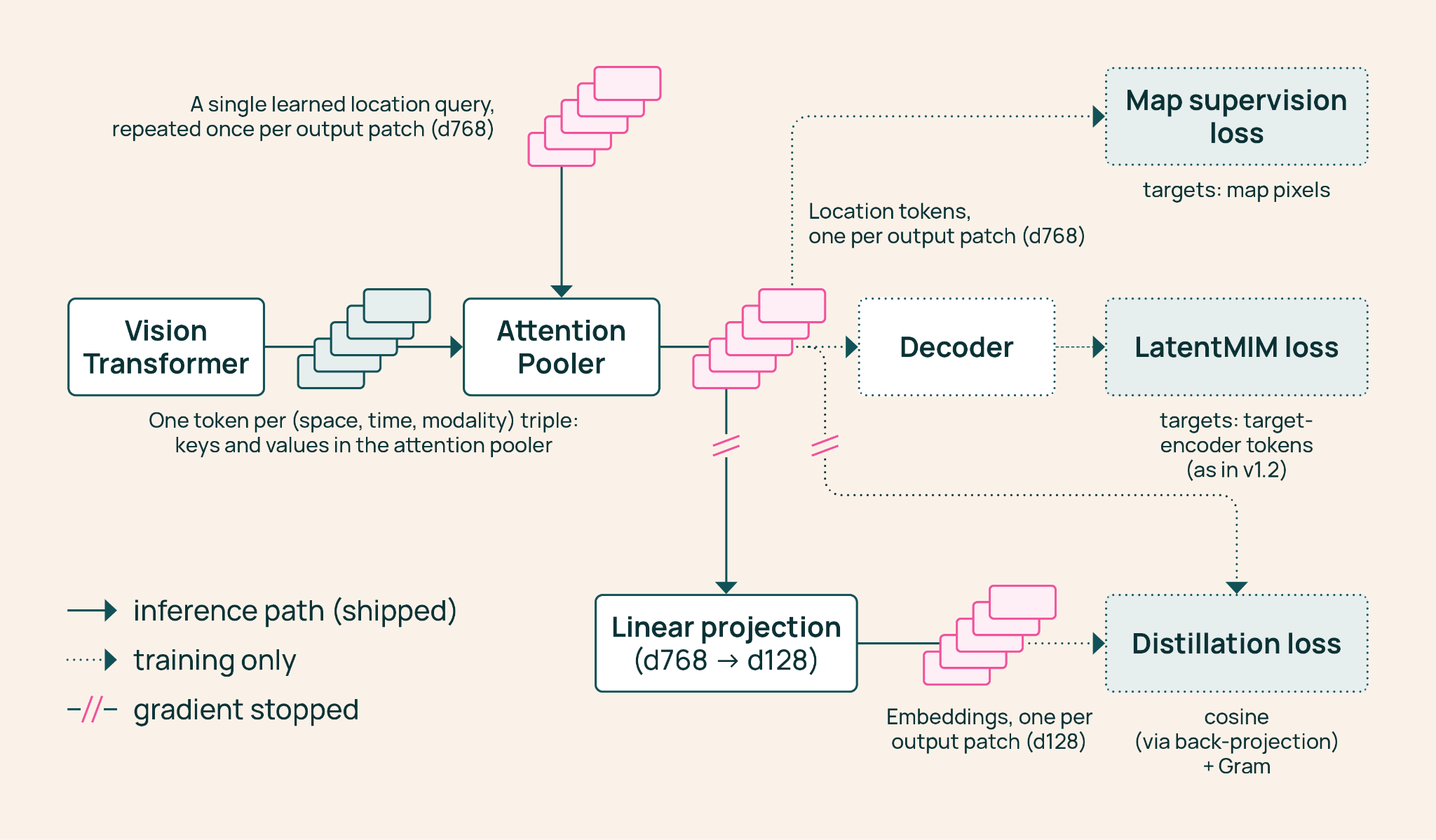
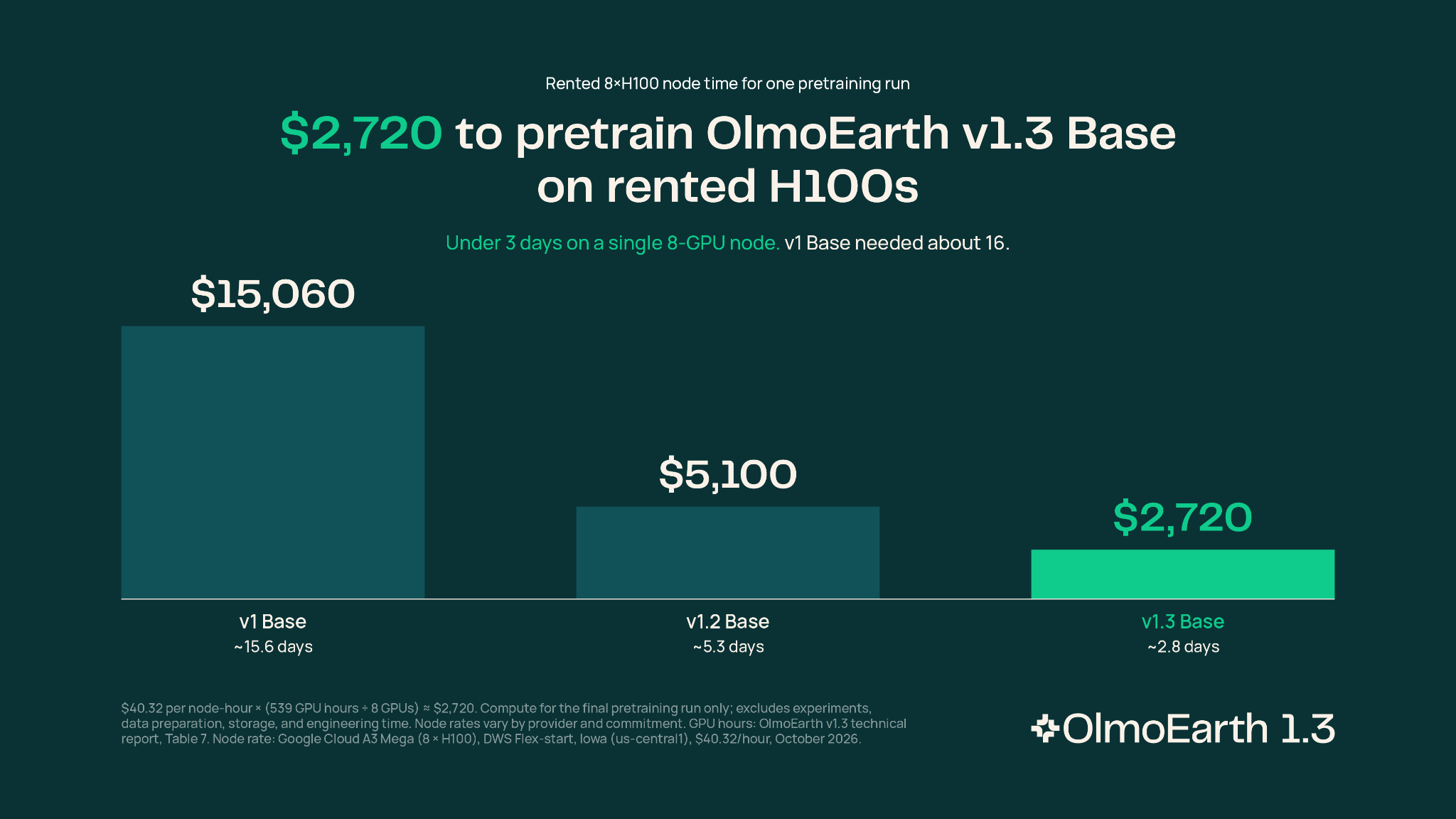
Allen AI announced the release of OlmoEarth v1.3 in a blog post dated October 22, 2026. According to that post, this is a satellite embedding model: it reads a year of radar (Sentinel-1) and multispectral (Sentinel-2 and Landsat) time series and generates a 128-dimensional vector for every 10-meter pixel on Earth, with the first 64 dimensions also usable as a smaller standalone embedding. Architecturally, a vision Transformer reads the satellite data, an attention pooler summarizes it into a single vector per parcel of land, and a linear layer compresses it to 128 numbers. The post states that across 27 evaluations spanning six continents and multiple tasks, the 128-dimensional embedding scored highest on 20, while the 64-dimensional version led on 18; the comparisons were against AlphaEarth Foundations (AEF) and Tessera v2, and a new crop-type benchmark for tropical agriculture called PLANTEUR was also introduced. The blog says model weights, pretraining data and pretraining code are all open, under the OlmoEarth Artifact License, the same as v1 and v1.2. Released alongside it are global precomputed annual embeddings at 10-meter resolution in both 64 and 128 dimensions, data hosted on Source Cooperative, and a no-login browser tool called the OlmoEarth Embeddings Explorer. The blog states a final pretraining run of OlmoEarth v1.3 Base takes roughly USD 2,720 of rented H100 time; the embedding archive is about 150 TB per year, with global coverage for 2025, 2024 and 2023, and partial country coverage for 2017 to 2022 at release time.
What it means for developers
For developers, this release shifts the center of gravity of the satellite-data mapping workflow from fine-tuning to feature reuse. The blog explicitly notes that the main way to use OlmoEarth previously was fine-tuning the model per task in OlmoEarth Studio, which requires GPU access and the ability to download and store imagery; the embedding model is positioned to compress satellite data into directly reusable features, making classifier training a lightweight local modeling problem. For teams with limited resources, this means they can run a first-pass analysis with a small number of labeled points in the Embeddings Explorer without a GPU, then decide whether fine-tuning compute is worth it. A second impact is data accessibility: the team published precomputed embeddings covering the whole planet and claims a provenance table for every 20-kilometer grid cell and year, listing the Sentinel-1, Sentinel-2 and Landsat scenes the model read plus links to public catalogs, so pixels can be traced back to their imagery source. This lowers the barrier to building a remote-sensing feature pipeline, but it also shifts the dependency to the official archive's coverage, update cadence and license terms. On training cost, the blog compares v1.3 as taking 53 percent of v1.2's compute time and 18 percent of v1's, with 50 percent and 22 percent of the carbon emissions respectively, while claiming performance on research and partner labels comparable to v1.2. These figures are the provider's own and await third-party reproduction.
Integration and evaluation
Before deciding whether to adopt, developers should make a few conditional judgments. The first decision is whether the task allows local fine-tuning: the blog claims v1.3 is also a strong fine-tuning model, performing comparably to v1.2 on research and partner labels (a provider claim). If your task already has historical labeled data and needs task-specific accuracy, first fix the same set of validation labels and compare v1.3 embeddings plus a small classifier against your existing v1.2 baseline; only invest in a full fine-tuning pipeline if the gap on the validation set is clear and stable. Measurable criteria are classification accuracy or mean intersection-over-union on that same validation set, and the number of labels needed to hit the target accuracy. The second decision is whether you need to generate embeddings yourself: officially precomputed global 64- and 128-dimensional embeddings are available, but the blog says 2025, 2024 and 2023 have global coverage, while 2017 to 2022 covers only some countries. If your study window falls outside that coverage, or you need custom dates, modalities or resolutions, you will need to generate embeddings on your own compute using OlmoEarth Studio or the tutorial mentioned in the blog; in that case, run a small-area end-to-end trial first, with the acceptance criteria being whether you can reproduce the official embedding dimensions and provenance records. The third decision concerns licensing and distribution: the blog says all weights, data and code are released under the OlmoEarth Artifact License, the same as v1 and v1.2. That name is not a common OSI-style open-source license, so before redistributing weights or using embedding outputs in commercial products, read the license terms clause by clause to confirm the scope of redistribution and commercial use, and do not infer license rights merely from weights being available. All of the above are conditional suggestions based on the source information, not verified conclusions.
Limits and open questions
First, it must be clear that OlmoEarth v1.3 does not currently appear in KimiSeek's live model catalog; everything here about model capabilities, data and tools comes from the Allen AI blog and is unrelated to availability on the KimiSeek platform. The evaluation results in the source (highest score on 20 of 27 evaluations, comparisons with AEF and Tessera v2) and efficiency figures (53 percent of v1.2's compute time, 18 percent of v1's) are provider claims, and this brief did not independently reproduce them. The blog says model weights, pretraining data and code are all open, but the license is the OlmoEarth Artifact License, not a standard OSI open-source license, and the exact rights boundary must be determined from the license text itself. The precomputed 2017 to 2022 embeddings cover only some countries; if your study area is not covered, you must generate embeddings yourself, and the self-hosting path mentioned in the blog depends on its tutorial and local compute. The roughly USD 2,720 H100 rental cost is only an estimate for the final pretraining run; it excludes data preparation, storage and debugging overhead, and hardware rental prices change over time, so it should not be used as a budget baseline. The Embeddings Explorer's descriptions of results in seconds and no GPU requirement are based on the official tool; actual speed depends on network and data download, and experiences may differ across environments.
Illustrations from the original report