Reflection AI Releases Open-Weight Model Beam: 501B Total Params, 23B Active, Apache 2.0 Weights Pending
According to a MarkTechPost report on October 5, 2026, Reflection AI released its first open-weight model Beam, with 501B total parameters and 23B activated per token, targeting coding and agent tasks, supporting a reasoning effort parameter and up to 1 million token effective context, with Apache 2.0 weights planned for release later in October 2026; it is still in red teaming and only a waitlist is open.
What changed
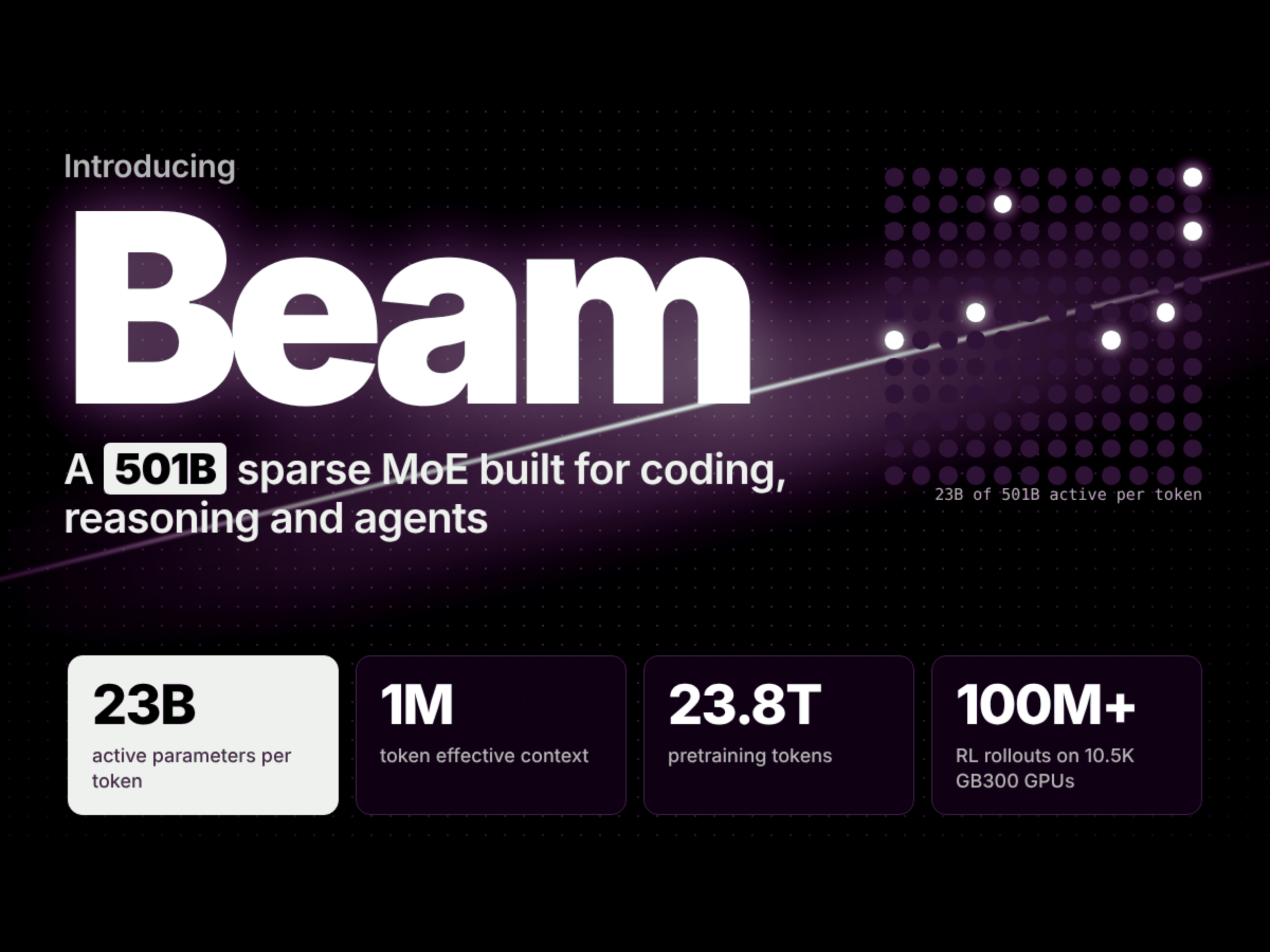
According to a MarkTechPost report on October 5, 2026, Reflection AI released its first open-weight model Beam. Beam is a sparse mixture-of-experts model with 501B total parameters, 23B activated per token, aimed at coding, reasoning and agent workloads, supports text input only, and has an effective context of 1 million tokens. The Reflection team says Beam directly targets larger open models such as GLM 5.2, needing 3 to 4 times less inference compute on reasoning benchmarks, while acknowledging that Kimi K3 still leads in raw capability. The model provides a reasoning effort parameter that can be adjusted by task difficulty and compute budget. Pretraining used 23.8 trillion tokens and was completed in under 4 weeks on 6,144 NVIDIA GB300 NVL72 GPUs; the reinforcement learning phase trained for 4 weeks on 10.5K GB300 GPUs, producing over 100 million rollouts, with a maximum rollout context of 256K tokens. Reflection's self-reported scores are SWE-bench Verified 80.9 and Terminal Bench v2.1 80.1. The report says Beam is still in final red teaming, self-hosting is not yet available, early access is open through a waitlist on the Reflection platform, and Apache 2.0 weights are planned for release later in October 2026.
What it means for developers
Based on the specifications disclosed in the report, Beam's positioning is not simply to match the strongest open models, but to push active parameters per token down to 23B while keeping total parameters at 501B, trading efficiency for a lower deployment barrier. For developers, what this directly changes is the inference cost structure: if the claim of 3 to 4 times compute savings holds, the same coding or agent tasks could achieve comparable throughput on fewer GPUs, but this is the Reflection team's claim, not an independently reproduced conclusion. The second layer of impact is licensing: the report says Beam plans to use Apache 2.0, while Kimi K3 in the comparison table uses a custom license with additional attribution requirements for very large-scale products, GLM-5.2 and DeepSeek V4.1 Flash use MIT, and Nemotron 3 Ultra uses OpenMDW-1.1. It should be emphasized that weights becoming open and license terms taking effect are two different things; Apache 2.0 was still a plan at the time of the report, and no usage rights should be treated as in effect until the weights are actually released with a license. The third layer of impact is capability boundaries: Beam supports text only, unlike DeepSeek V4.1 Flash and Kimi K3 in the table which support text plus images, so multimodal workloads still need another model. On benchmarks, DeepSeek V4.1 Flash and Kimi K3 still lead on Terminal Bench v2.1, indicating that an efficiency advantage does not equal an overall capability lead.
Integration and evaluation
The following is suggested analysis and conditional reasoning, not reported fact. Decision one: whether to include Beam in the candidate pool for coding agents. The report says its SWE-bench Verified score is 80.9 and Terminal Bench v2.1 score is 80.1, both self-reported by Reflection; the precondition is that the weights and license are actually released as stated, otherwise evaluation is currently only possible through the waitlist. An actionable evaluation criterion is: on patch generation tasks in your own repository, compare the pass rate and per-task token consumption against your current model, and only if the pass rate is close while token consumption drops significantly is there value in switching. Decision two: how to handle the cost and quality trade-off introduced by the reasoning effort parameter. The report says the low setting favors shorter answers while the high setting allows longer reasoning, which is a control point unique to Beam; it is suitable for pipelines with widely varying task difficulty distributions. The selection principle is: first hold other variables fixed, run the same batch of hard problems at low, medium and high settings, record correctness and total output tokens, find the inflection point of the cost curve, and then decide which setting to make the default, rather than using a single setting globally. Decision three: pre-checks on licensing and compliance. Before the weights are released, whether they are actually released under Apache 2.0 and whether the license file accompanies the weights should be listed as preconditions for going live; if the release terms differ from the report's expectations, the switching decision needs to be redone. The evaluation criterion is whether the license file is provided together with the weights and whether its terms match expectations.
Limits and open questions
At the time of the report, Beam was still in final red teaming, self-hosting was unavailable, and early access was only open through a waitlist on the Reflection platform, so local weight testing is not currently possible. All benchmark scores come from Reflection's self-published table, with competitor scores cited from Artificial Analysis and DataCurve, and there has been no independent third-party reproduction, so SWE-bench Verified 80.9 and Terminal Bench v2.1 80.1 should be treated as vendor self-reported data. Apache 2.0 is described as a plan, with weights planned for release later in October 2026; as of the current catalog check, this release version of Beam is not listed on KimiSeek, and the API and platform availability mentioned in the report refer to Reflection AI's own side and are unrelated to this site's catalog. Safety evaluation results are reported to be published in a technical report, with no specific data currently available. The claim of 3 to 4 times inference compute savings comes from the Reflection team, and the test conditions, baseline choices and measurement methods are not explained in the report. Whether the efficiency gain can be reproduced in self-hosted environments remains unknown.
Illustrations from the original report