Reflection AI Releases Open-Weights Beam 501B Model: Apache 2.0 Weights and Two AWS Deployment Paths
According to an AWS blog post published on October 16, 2026, Reflection AI has introduced Beam, an open-weights model aimed at agentic coding and long-horizon tasks. It has 501B total parameters and 23B activated parameters, a reported effective context of 1 million tokens, weights released under Apache 2.0 via Hugging Face in BF16, FP8 and NVFP4 checkpoints, and two deployment paths: SageMaker JumpStart and HyperPod.
What changed
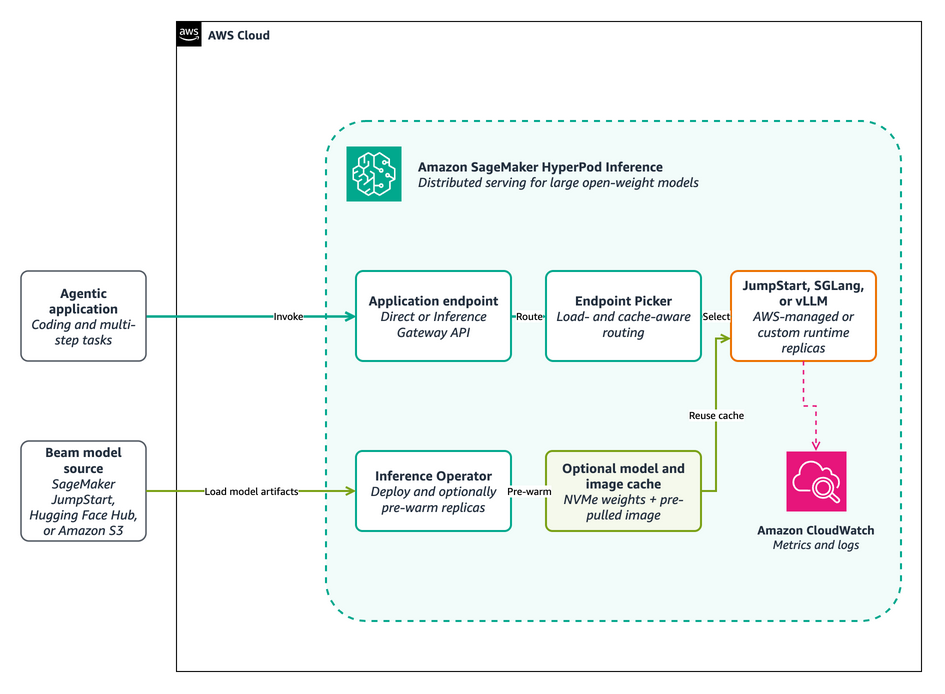
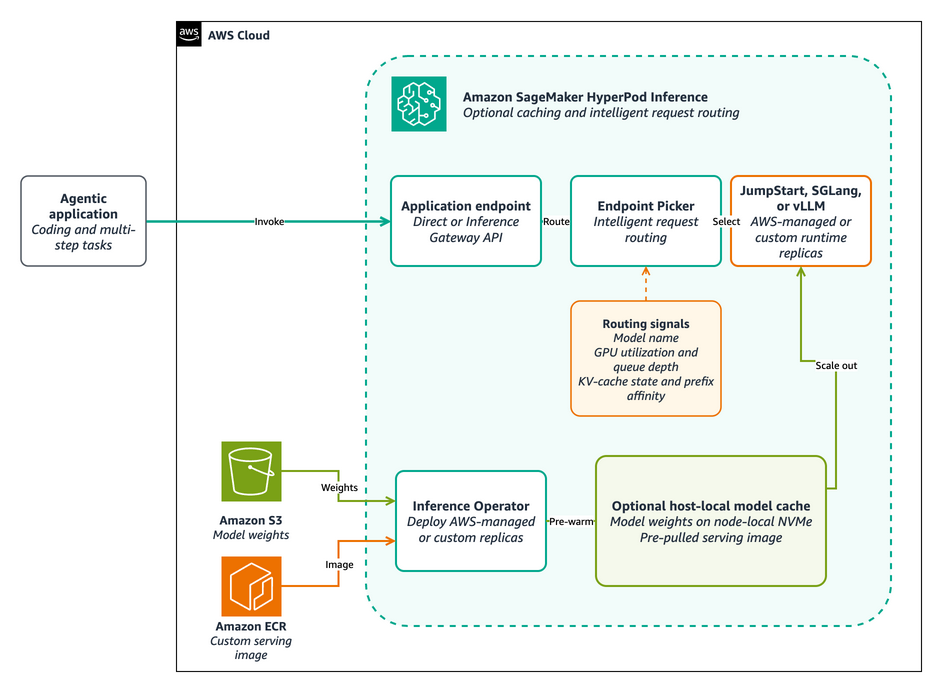
According to an AWS official blog post dated October 16, 2026, Reflection AI released the open-weights model Beam, positioned for agentic coding and long-running tasks such as maintaining code, calling tools, interpreting results and completing multi-step workflows. The model is a sparse mixture-of-experts (MoE) architecture with 501 billion total parameters and 23 billion activated parameters, with Reflection reporting an effective context length of 1 million tokens. Reflection released the Beam weights under the Apache 2.0 license via Hugging Face; Beam 1.0 offers BF16, FP8 and NVFP4 checkpoint variants to suit different memory footprints and hardware. At launch the model was available in Amazon SageMaker JumpStart in two US East regions (Northern Virginia and Ohio). The blog also describes two deployment paths: SageMaker JumpStart real-time endpoints (fully managed) and SageMaker HyperPod Inference (with JumpStart managed containers or custom SGLang and vLLM). It further provides instance-selection guidance by precision: FP8 uses H100 ml.p5.48xlarge or H200 ml.p5e/ml.p5en.48xlarge; NVFP4 uses B200 ml.p6-b200.48xlarge; and it emphasizes that BF16 weights have the largest memory requirement and need multi-node planning. Note in parallel that this is a reportorial description from that blog; KimiSeek has not independently verified model capabilities, instance support or regional availability.
What it means for developers
The direct consequence for developers is that this is an open-weights release, stated to be under the Apache 2.0 license, which is clearer at the licensing level than weights merely being downloadable. License rights should still be based on the Hugging Face repository and the terms text, and weight availability alone cannot be used to infer authorization for commercial use, redistribution or derivative training. On the engineering side, the 501B/A23B sparse structure means VRAM and deployment cost are driven by total parameters, while per-token compute is closer to the 23B activated scale, so weight memory, sharding and parallelism layout are the primary constraints: BF16 requires aggregate memory across multiple nodes, while FP8 and NVFP4 narrow feasible hardware to specific H100/H200 and B200 instances. There is a real trade-off in deployment form: JumpStart real-time endpoints package the model, container and endpoint into a managed workflow, suitable for quick validation; HyperPod exposes the cluster and runtime, allowing fixed image digests, Beam commit SHAs and parallelism parameters, suitable for teams that need reproducible performance results or custom quantization and parsers. The 1 million token effective context mentioned in the blog affects KV cache budgets and batching strategy, and long-context VRAM usage needs to be measured rather than estimated. For evaluation, the model targets multi-step tool calling, so single-turn question-answering benchmarks are insufficient to show its behavior in real agent loops; workloads should be constructed from representative coding and tool-use requests.
Integration and evaluation
The following evaluation suggestions are based on the blog and are not verified conclusions. First, decide between managed and self-managed: if the goal is to get an integration running quickly and the team lacks Kubernetes operations capability, use a JumpStart real-time endpoint for a bounded lifecycle (deploy, single request, clean up), setting the success condition as the endpoint returning a response that conforms to the published request schema once ready. Only move to SGLang or vLLM on HyperPod when you need fixed runtime parameters, quantization or custom parsers, in which case the pass condition is reproducibility of the image digest, model revision and parallelism configuration. Second, make a capacity decision by precision: estimate aggregate VRAM from single-replica weights, KV cache and runtime overhead, then correct it with load testing; if the target context approaches the reported effective limit, first verify whether p95 time to first token and time per output token under long context meet latency budgets, and if using NVFP4 or FP8, re-check output quality for degradation. Third, set a measurable acceptance line for agent scenarios: stress with real code-fix and multi-step tool-calling requests at expected concurrency, recording success rate, p50/p95 time to first token, end-to-end latency and aggregate output throughput, and document model version, image digest, precision, context length and cache state together; otherwise comparisons across configurations are not comparable. Fourth, validate at small scale before scaling up: confirm service quotas and regional capacity for the chosen instance type, note that image transfer, weight download and shard loading can consume considerable cold-start time, and base caching and autoscaling policies on measurements rather than assumptions. Fifth, after testing, clean up endpoints, clusters, cached weights and temporary IAM resources per official examples to avoid ongoing billing.
Limits and open questions
Beam 1.0 (501B/A23B), the model in this release, is not currently listed on KimiSeek, so the deployment paths, invocation methods and any availability described here refer to the release channels of Reflection AI and AWS, not to this site's services; Kimi K3, GLM, Qwen, DeepSeek and others on KimiSeek are different models and do not constitute evidence of availability for this version. This report is based on a single source, the AWS blog; KimiSeek has not independently verified the parameter counts, effective context length, the actual scope of the Apache 2.0 license, hardware compatibility of each checkpoint variant, availability status in the two US East regions, or the model's benchmark performance; the blog provides no public coding or agentic benchmark scores, and capability claims should not be treated as verified facts. Open weights are not the same as fully open source: license terms, training data and reproducibility materials still need to be confirmed against the Hugging Face repository and Reflection's official statements. The HyperPod caching, routing and gateway capabilities mentioned are within the scope of SageMaker features as of 2026, and their behavior changes with versions; refer to the corresponding documentation. Instance types and regions may also change over time. For cost, refer to the respective pricing or billing pages of Reflection AI, Hugging Face and AWS; prices and quotas change. In addition, the sampling parameters in the blog (such as temperature and top-p) are example starting values only and do not represent recommended configurations.
Illustrations from the original report