Reflection Beam and Mistral Large 4 Debut Together: More Open-Weight Options, but Weights and Licenses Still Pending
According to an October 2026 report from InfoQ Chinese, US-based Reflection released Beam, its first open-weight MoE model, on October 5–6, one day before France's Mistral launched Mistral Large 4, its largest model to date. The report says Beam's selling point is inference efficiency, with some benchmarks approaching GLM-5.2 but trailing China's latest generation; Large 4 is available in API preview, with full weights planned for late October release. Neither version is currently listed on KimiSeek.

What changed
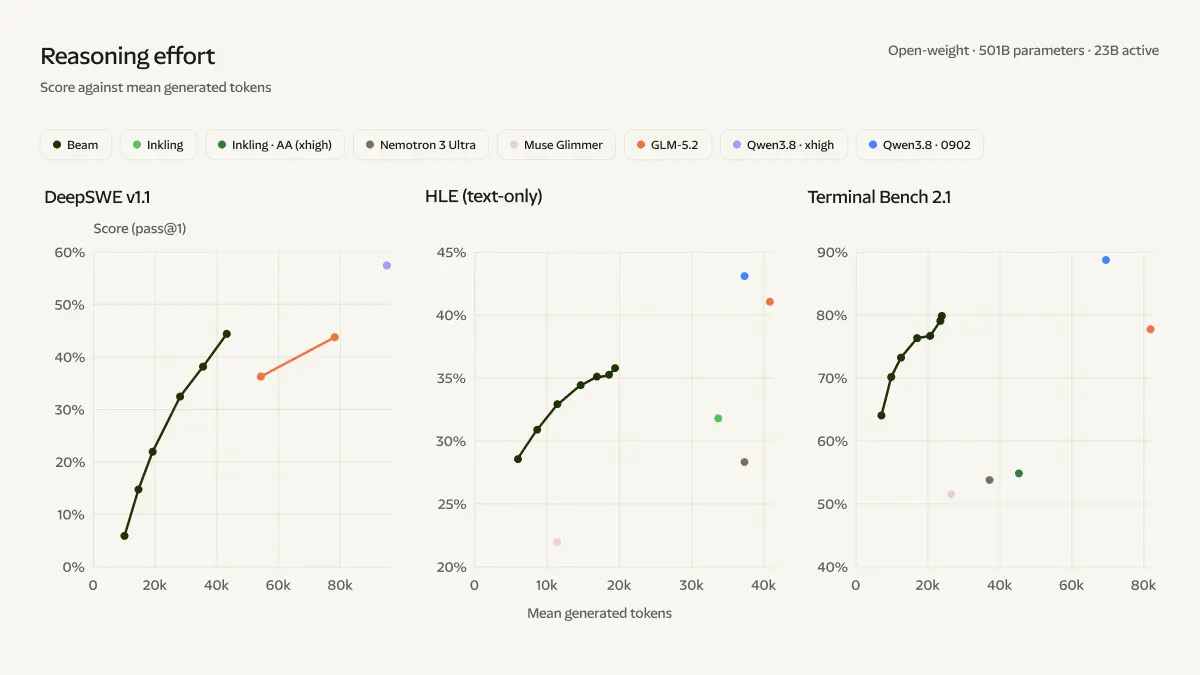
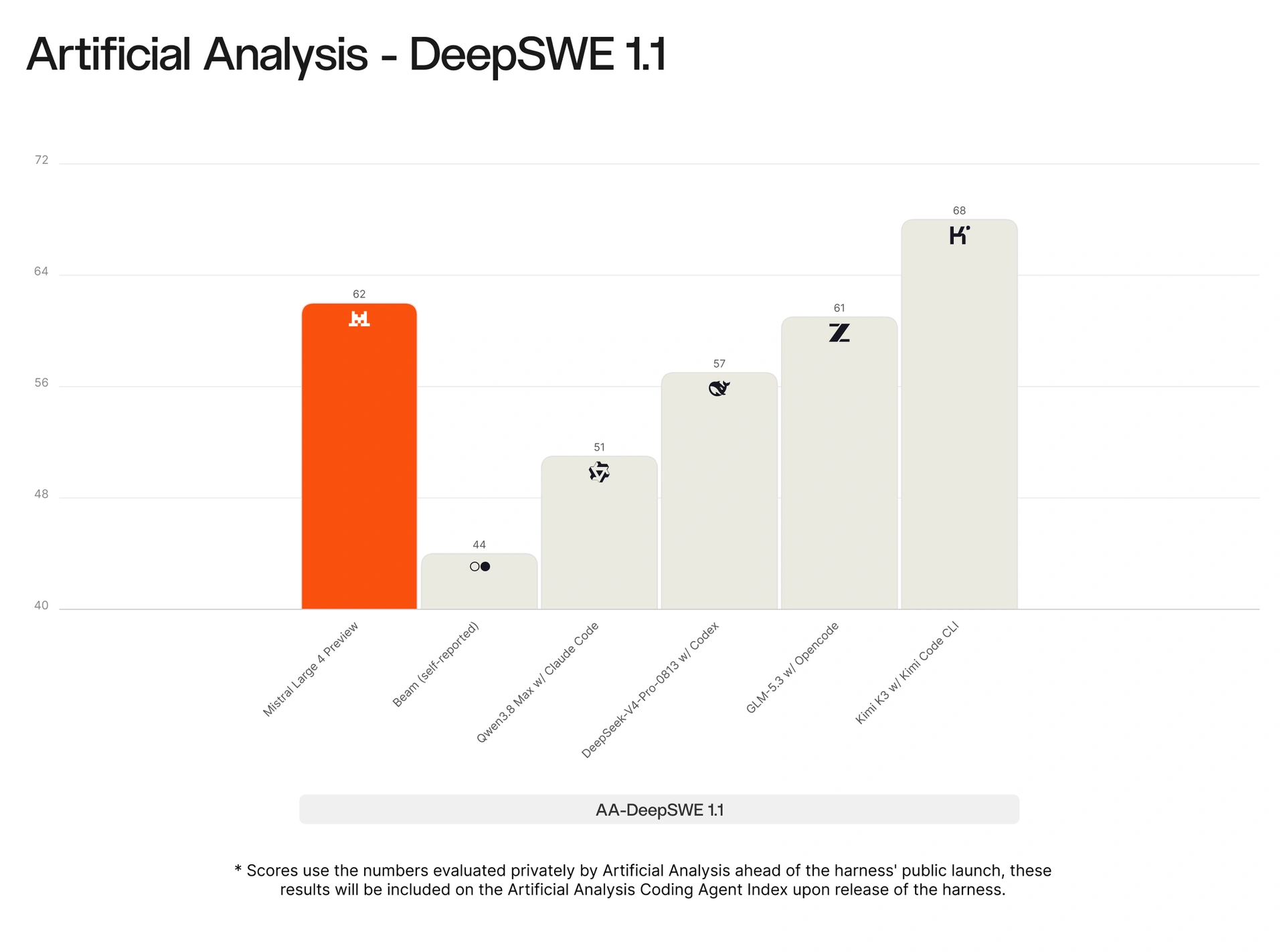
According to InfoQ Chinese (which dates the events to local time October 5–6), US startup Reflection released Beam, its first open-weight model, and a day later France's Mistral launched Mistral Large 4. The report describes Beam as an MoE model with 501 billion total parameters and 23 billion activated per token, aimed at coding, reasoning and agent workloads, pretrained on 23.8 trillion tokens, and using 10,500 Nvidia GB300 GPUs for four consecutive weeks of high-compute reinforcement learning generating over 100 million rollouts; it was still in final red-teaming at launch, and Reflection reportedly planned to publish weights, a technical report and developer tools in October. Mistral Large 4 is reported to have 52 billion activated parameters and 1.05 trillion total parameters, including a 1.6 billion-parameter vision encoder, native multimodality, support for more than 160 languages, and a 1 million-token context window, reportedly trained from scratch in European data centers on about 3,800 Nvidia Grace Blackwell GPUs; it was in API preview at the time of reporting, with full weights planned for late October. In the benchmark data relayed by the report, Beam scored 44.4 on DeepSWE v1.1 and 80.1 on Terminal Bench v2.1, both below the reported scores of GLM-5.3, Kimi K3 and DeepSeek V4.1 Flash; on Humanity's Last Exam Beam scored 36.2, below GLM-5.3's 42.3 and Kimi K3's 46.9 also listed in the original (the original did not give a DeepSeek V4.1 Flash score for that benchmark). On the Mistral side, the report says Large 4 surpassed DeepSeek V4 Pro and Qwen 3.8 Max but trailed Kimi K3 on the official Coding Agent Index, and surpassed Kimi K3, MiMo-V2.6-Pro and DeepSeek V4 Pro but trailed GLM-5.3 on AutomationBench. These scores come from vendor self-reports or third-party tests cited by the vendors, are relayed by the report, and have not been independently reproduced.
What it means for developers
What this set of releases changes is the candidate pool and comparison frame for the open-weight camp, not the immediate availability of Chinese models. The most engineering-relevant point is that Reflection shifts Beam's selling point from absolute capability to how much intelligence you get per unit of inference compute; the report says some advanced reasoning tasks can approach similar performance using roughly one-quarter to one-third of GLM-5.2's compute. If that claim holds on your own workloads, the impact is on the per-task cost structure of long-chain agents and batch inference. But by the benchmarks relayed in the report, Beam mainly matches China's previous generation, trailing GLM-5.3, Kimi K3 and DeepSeek V4.1 Flash on DeepSWE v1.1 and Terminal Bench v2.1 as listed in the original, and trailing GLM-5.3 and Kimi K3 on HLE; therefore "approaching capability with less compute" and "higher quality with equal compute" are two different substitution paths and cannot replace each other. Mistral Large 4 has a different emphasis: million-token context, native multimodality and multilingual support, plus the private-cloud or on-premises deployment and custom security policies emphasized in the report, pointing to cross-application enterprise workflows and scenarios requiring self-controlled data boundaries rather than pure coding benchmark competition. A conceptual distinction is required: both are described as open-weight, but the reported timing of weight availability differs, and at launch neither had actually open weights; open weights means downloadable model files, which is a different question from whether training data, training code and license terms are open. The report provides no license details, so no commercial use, redistribution or fine-tuning rights can be inferred from it. Also, per a check of the current catalog, neither Beam nor Mistral Large 4 has a corresponding entry on KimiSeek; the API preview and availability described in the report refer to the vendors' own channels.
Integration and evaluation
The following is conditional analysis or advice, not reported fact. First, if the main workload is long-chain agent coding and is cost-sensitive: the report says Beam can approach GLM-5.2's performance at roughly one-quarter to one-third of its inference compute, while currently available comparable options include GLM-5.2 and DeepSeek V4.1 Flash; you could first run a small-sample comparison on your own multi-turn tool-calling traces, measuring "total tokens and end-to-end latency per completed task," provided you can accept performance below China's latest generation as reported in the benchmarks; if a higher failure rate triggers retries, the compute savings are offset, and substitution is not advisable in that case — you could set the evaluation criterion as an end-to-end success-rate drop of no more than a preset threshold on the same task set. Second, if the workload requires million-token context, multimodal input or multilingual support: Mistral Large 4 is reported to support a 1 million-token context and more than 160 languages, but weights and final terms are undecided, so you should first validate long-context retrieval accuracy and the vision encoder's performance on your own documents during the API preview, measuring long-context QA accuracy and cost per request, provided you do not equate preview behavior with future open-weight behavior and keep your current primary model as a fallback. Both rules should be reviewed again once weights are formally released and licensing is clear.
Limits and open questions
The report's content comes mainly from vendor self-reports and third-party tests cited by the vendors; benchmark scores have not been independently reproduced and should not be treated as verified conclusions. In particular: the original gives only Beam 36.2, GLM-5.3 42.3 and Kimi K3 46.9 on Humanity's Last Exam and does not list a DeepSeek V4.1 Flash HLE score, so the HLE comparison should be limited to GLM-5.3 and Kimi K3 as actually listed; merging the three benchmarks into "below all three" is a cross-benchmark comparison the original does not support. In addition, neither Beam nor Mistral Large 4 has a corresponding entry in KimiSeek's current models, meaning the two versions are not currently listed on KimiSeek; the API preview and weight-release plans described in the report refer to availability through the vendors' own channels and are unrelated to whether KimiSeek offers them. Weight availability is not equivalent to an open-source license; the report gives no license terms, so commercial use and redistribution rights depend on the license the vendors actually release. The report says Beam's weights are planned for October publication and Large 4's full weights for late October; at launch neither had actually open weights, and whether these are delivered on schedule and how the terms change remain unknown. The "roughly one-quarter to one-third compute" claim is Reflection's own statement, lacks an independent measurement basis, and actual substitution results need validation on your own workloads. This brief does not judge whether the two companies' future roadmaps or business model commitments will be fulfilled.
Illustrations from the original report