Supersonic Labs Releases Julia 1: A 144.3M-Parameter Apache 2.0 Decision Model That Runs on CPU at the Edge
According to a MarkTechPost report dated September 26, 2026, Brazil-based Supersonic Labs released Julia 1, a 144.3-million-parameter decision model built on mmBERT-small, with weights released under Apache 2.0, supporting three call types (choice, score, noul), runnable locally on CPU. Its trials exceeded the Jev reference values on Typed Decisions, AG News, and DAIR Emotion, but lagged clearly on 72-label Banking77; a hosted API has been announced but is not yet available.

What changed
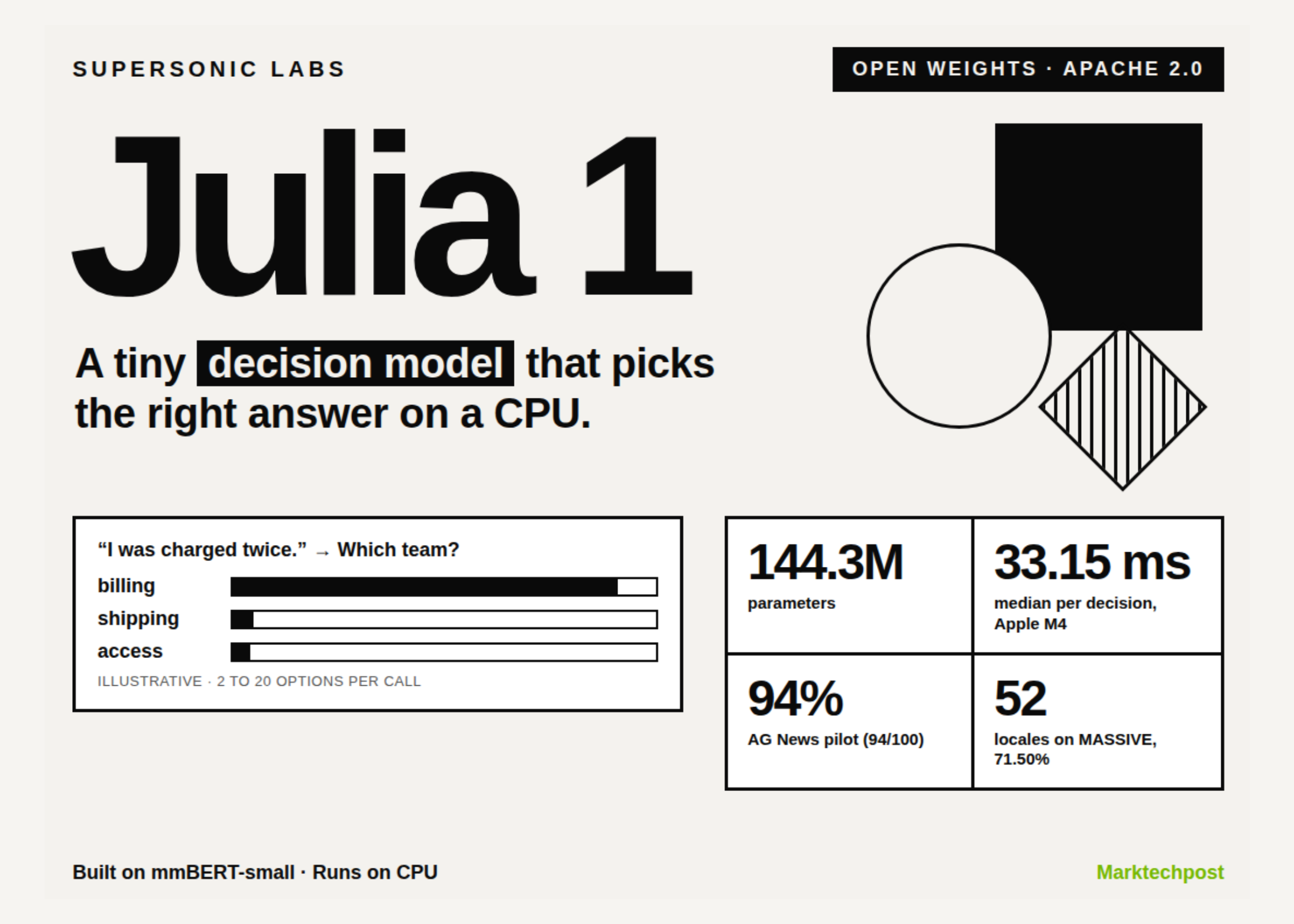
According to a MarkTechPost report dated September 26, 2026, Brazil-based small lab Supersonic Labs released Julia 1 (note: this version is not currently listed in the KimiSeek catalog; the API availability mentioned in the report refers to the vendor's side). It is a decision model, not a chat model: callers pass in context, a question, and 2 to 20 described candidate answers, and the model returns the selected item in the given order along with full softmax probabilities; the caller ID is returned unchanged, and no free text is generated. The weights are released under Apache 2.0 on Hugging Face (weight availability does not equal an open-source license; here the source explicitly states Apache 2.0). Under Python 3.11+, it can run on CPU or on BF16-capable GPUs, and an ONNX build can run in the browser via WebGPU; a hosted API has been announced but is not yet available. The model is based on the JHU CLSP mmBERT-small encoder plus a decision head, and the lab explicitly states it is not a fine-tuned Qwen. The runtime merged token limit is 8,192, while public benchmarks used 1,024. The three call types are choice (classification, routing), score (ordered scoring that returns the expected index), and noul (probability of true/false). The evaluation reported on September 24, 2026, ran on an H200 in BF16 with strict encoding, comparing against reference values in the TypeSafe Jev benchmark protocol rather than re-running Jev: Typed Decisions 73.15% (reference 72.70%), AG News 94/100 (reference 91%), DAIR Emotion 86/100 (reference 48%), Banking77 only 64/100 (reference 87%), MASSIVE macro-average 71.50% across 52 locales, pt-PT 86.25%, en-US 86.75%. Each classification trial used only 100 samples. A September 25 CPU run reproduced Typed Decisions 72.55% and Banking77 60/100 with 3 abstentions. On latency, the report states a median of 33.15 ms per decision on an Apple M4, a median of 203 ms and peak RSS of 393.1 MB on a Samsung SM-X510 tablet via ONNX Runtime, a median of 107.83 ms on AG News on an Intel Core i5-1235U, while Banking77 took 3,713.54 ms because it first needs to narrow down 72 labels.
What it means for developers
The direct impact for developers is that an optional path has emerged for pulling "classification/routing/scoring" out of large models and putting it on a small edge model. At 144.3 million parameters and roughly 550.5 MiB for FP32 weights, it can fit into phones, tablets, laptops, or even browsers, without paying per classification call or going online; the planned API price in the report is $0.025 per million input tokens, but that API is not yet available, and that price was reported in September 2026, so readers should confirm current pricing via the vendor's latest page rather than this article. At the same time, its capability boundaries must be recognized: it only compares among the candidates you provide, and cannot fill in missing facts or do algebra or multi-step computation; the Router may drop the correct label during narrowing, and it is not a drop-in replacement for existing Transformers pipelines; the report says no Hugging Face inference provider hosts it. At the benchmark level, the most important signal is not "three items beat Jev" but the sharp degradation as the label space expands from 4 or 6 to 72: AG News 94/100 versus Banking77 64/100, with CPU reproduction at only 60/100, indicating it suits coarse-grained, few-label decisions rather than fine-grained multi-class classification. In addition, the report's claim of being "5x faster than Jev" comes from a vendor X post, while the Jev trial measured Jev as a hosted service called from France, so the latencies are not an apples-to-apples comparison and should not be taken at face value.
Integration and evaluation
The following is conditional analysis and recommendations based on the report, not verified facts. First decision: whether to use the model's output directly for online automatic routing. The report's "more labels means worse" (Banking77 64/100, CPU 60/100) and "the Router may drop labels" are two different failure modes and should be handled separately; if your scenario has more than roughly twenty labels and a misjudgment would trigger irreversible actions such as charges, permissions, or refunds, do not execute the model output directly, but instead add a second-stage check or human review; if the number of labels is small (for example, coarse classification within 4 categories) and actions are rollback-able, you can start with a canary. Measurable evaluation criteria: on at least 200 real requests you sample yourself, compare the model's selected item against human labels for agreement, and separately count the proportion of cases where the correct answer is eliminated during the Router narrowing stage. Second decision: whether to use edge deployment to replace existing hosted classification calls. The measured device results in the report are a median of 33.15 ms on M4, 203 ms on SM-X510, 107.83 ms on AG News on i5-1235U, while Banking77 reaches 3,713.54 ms, meaning the number of candidates or label scale is the precondition for feasibility; when your requests are mostly short texts with few labels and you can accept hundred-millisecond, offline local inference, edge deployment is more cost-effective; when the label scale is large or you need low latency and high concurrency, the edge CPU path may not hold. Measurable evaluation criteria: on your target device with fixed input length, stress-test P50 and P95 latency and peak memory for each decision type (reported reference value RSS 393.1 MB), and compare on the same machine against your existing solution. Third decision: whether to migrate your business to the hosted API now. The report explicitly says the API has been announced but is not yet available, so at this stage you can only self-host; it is advisable to first validate at small scale with local weights, and decide whether to switch only after confirming API-side availability, rate limits, and billing, not doing capacity planning based on the planned price in the report. As for evaluation steps, it is advisable to first fix inputs within 1,024 tokens and construct candidates as per the report's protocol, run offline agreement tests, then perform device stress tests, and only go to canary after both pass.
Limits and open questions
The core limitations of this report are the samples and the comparison basis. Each classification trial used only 100 samples, and although Typed Decisions used 2,000 items, the confidence intervals for the others are wide, insufficient to support strong conclusions; the comparison baseline uses reference values from the Jev protocol rather than re-running Jev in the same environment, and the Jev latency was measured via cross-border calls to a hosted service, which is not comparable to local execution of this model, so the vendor's "5x faster" claim needs independent verification. The model's private training pipeline is not public, so data composition and potential bias cannot be checked. The September 25 CPU reproduction showed 3 abstentions, indicating that behavior may degrade in low-spec environments. The hosted API claimed in the report was not yet available at the time of writing, and the planned $0.025 per million input tokens price comes from a September 2026 report; prices change, so refer to the vendor's pricing page. It should be specifically noted that the Julia 1 version is not currently listed in the KimiSeek catalog, and the API availability mentioned in the report refers to the vendor's arrangements and is unrelated to the KimiSeek platform. In addition, the report does not provide details such as candidate answer wording, order sensitivity, or multilingual stability (MASSIVE reports only a macro-average and two locales), all of which may affect real-world performance and need to be confirmed by readers through their own testing.
Illustrations from the original report