Tencent Cloud's WAND on AI video: ten generations per usable shot, and what that means for cost
InfoQ China reported on November 8, 2026 that Zhu Lin, head of Tencent Cloud WAND, said AI short comic dramas take roughly ten generation attempts per satisfactory result. Tencent Cloud says WAND has helped clients cut overall production costs by about 20%, and Mansen Culture's shot usability rate rose from about 30% to 50%–80%. The report gives no WAND pricing, billing method, weights or public API.
What changed
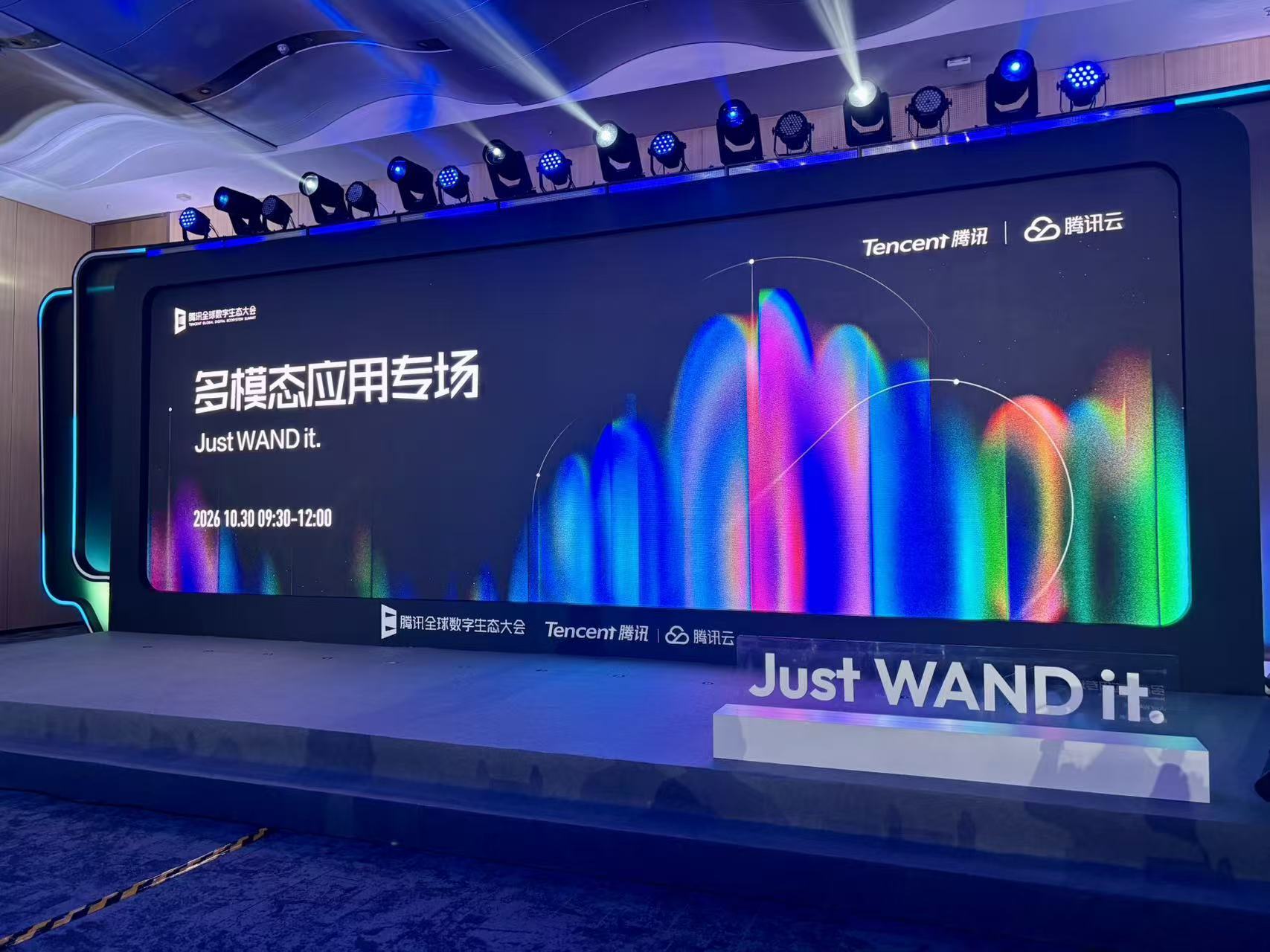
According to an InfoQ China article dated November 8, 2026, Zhu Lin, head of multimodal applications for Tencent Cloud WAND, said at the October 30 Tencent Global Digital Ecosystem Summit multimodal session and in a follow-up interview that, by industry experience, one AI short comic drama may need about ten generation attempts from storyboard to final cut to get one satisfactory result. On that basis the article notes that multimodal services are usually billed by calls, video duration or output specifications, so per-call price does not equal per-finished-piece cost, and illustrates with a set of hypothetical numbers: if one generation costs 10 yuan and about ten are needed for a usable shot, generation alone is about 100 yuan; if the usability rate rises to about 50%, about two attempts suffice and the cost is about 20 yuan. These figures are the article's illustrative arithmetic, not any vendor's quote. Tencent Cloud says its audio-video AI product family WAND, launched this year, has helped clients cut overall content production costs by about 20%. Interviewed clients give finer numbers: Tan Lin, assistant general manager of Mansen Culture, said shot usability rose from about 30% to 50%–80%, and can stabilize at about 80% with refined operations; the company's premium AI short dramas cost about 100,000–200,000 yuan per title, and using WAND-related capabilities saved about another 30% with about 30% overall efficiency gains. Du Yusheng, co-founder of Zixun Technology, said that after adopting WAND-Vega, the effective usage rate of image assets rose from 50%–60% to 70%–80%. On the technical path, Li Zhicheng, Tencent Cloud vice president and head of media AI products, said WAND-Vega is not a general foundation model trained from scratch but is post-trained and tuned on Tencent Hunyuan and some open-source base models, and comes in a cost-oriented Lite tier and a quality-oriented Pro tier. The report says that, with results broadly aligned with some mainstream industry models, the cost-sensitive option can cut model costs by about 20%–30%. Tencent Cloud describes two engineering approaches: first, a 3D white-model pre-pass for complex film and TV scenes, generating a simplified scene video in 3D software to fix object positions, spatial relations and some motion information, then feeding it to the video model as reference; second, WAND-EraseVibe+, latent-space Transformer-based video erasure and reconstruction that encodes frames into latent features, infers and reconstructs the regions to be repaired at the feature level, then decodes. Chaining script, storyboard, image generation, post-processing and editing in an Agent workflow is how Mansen Culture wired WAND's video generation and quality enhancement into its own production platform, not a product capability Tencent Cloud disclosed. Another business lead said on site that 82% of video model calls in its platform's Creative OS were initiated by Agents; the report does not say which company owns the platform or when the figure was measured. Li Zhicheng also said that even leading video generation models still have unsolved problems in film and TV scenes with complex lighting and physics. The article also cites a September 2026 study on long-form narrative-to-film generation (CineCrew), which argues prompt-based workflows tend to fail partly because there is no structured intermediate layer between script and video model to express constraints on shots, characters and continuity.
What it means for developers
The point of this report for developers is not another video generation product but a shift in the cost coordinate: when billing is per call or per duration, what really drives the ledger is how many generations each usable asset consumes. Extending the article's own arithmetic: if unit price and acceptance criteria stay fixed, generation cost per usable asset moves roughly with the inverse of first-pass usability. Raising usability from one in ten to one in two cuts cost to about one fifth, not half. Batch production cost is therefore highly sensitive to usability, and retry budgets, queue waits and manual screening scale up or down with it. These are inferences from the report's example, not a validation of WAND's results. The report gives no WAND API name, rate limits, regions, concurrency or SLA, and does not say whether billing is per call, per duration or per output spec. Before wiring it into a pipeline, design retries, task idempotency and asset accounting for the worst case: multiple attempts on the same storyboard should be identifiable as one task, and accepted assets should be locked to disk so later fixes or re-layout do not trigger regeneration again. The pre-generation constraint layer deserves separate evaluation: a white model splits what the script says from how the shot is filmed, and if you already have storyboard tools or 3D assets, the added work is a data conversion and validation layer, not another model call. Whether local repair saves money also depends on engineering conditions: it beats full regeneration only when defects can be located and repair does not change accepted regions. As for Agent orchestration, the 82% figure lacks definitions and a measurement date, and the interviewees stress that professional teams need intermediate results that can be inspected and edited, meaning the ceiling on automation depends on whether your intermediate artifacts are stored in structured form.
Integration and evaluation
The following are conditional suggestions based on the report, not reported facts. First decision: define the metric before discussing unit price. Relative to the reported rule of thumb of ten generations and the 30%–80% usability range, choose first-pass usability and generations per usable asset (including failed retries) as primary metrics rather than comparing per-call prices first. The premise is that you have a batch of tasks with acceptance verdicts attached, and acceptance criteria that can be written down; if the criteria can be judged automatically (for example, whether an e-commerce image preserves shape, color and brand marks), you can run batches directly, while multi-shot narrative work should start with a small sample. A measurable criterion is comparing first-pass usability and total generations per usable asset before and after adoption on that set of tasks carrying acceptance verdicts. Second decision: whether to add a structured constraint layer before generation. Relative to the reported 3D white-model reference for complex film and TV scenes, the choice is to insert explicit constraints on scene layout, object positions and shot continuity between prompt and video model. The premise is that spatial-relation and cross-shot continuity failures outweigh quality failures in your failure samples; if failures are mainly quality or style, this investment pays less. A measurable criterion is the difference in first-pass usability and full-segment regeneration counts for the same storyboards with and without constraints. Third decision: how local repair and full regeneration divide the work. Relative to the reported latent-space generative repair of WAND-EraseVibe+, the choice is to write "locate defect, repair locally, preserve accepted regions" into the process and use it only when the main subject has already passed acceptance. The premise is that defects can be located to specific time ranges and image regions, and you can verify untouched regions really did not change. Measurable criteria are the share of previously accepted regions altered after repair and whether generations per usable shot fall. Fourth decision: tiered routing. Relative to the reported Lite and Pro tiers of WAND-Vega and the claimed 20%–30% model cost reduction for cost-sensitive options, the choice is to route by a shot's weight in the final cut rather than using one tier for the whole piece. The premise is that you can grade shots by importance and accept that acceptance thresholds may differ by tier. Measurable criteria are pass rates and model cost per usable shot for each tier at the same acceptance threshold; if the lower tier's pass rate drops sharply on key shots, do not trade that away for a lower price. For Agent orchestration, add one more: put human intervention where accepted assets are modified, and measure whether further automation is worthwhile using the human intervention rate and the retention rate of assets after intervention.
Limits and open questions
All figures here come from Tencent Cloud and its clients at their own summit and in interviews, and are vendor-reported. The report gives no definitions or samples behind the 30%–80% usability range, the 20% overall cost saving or the 20%–30% model cost reduction, and there is no third-party reproduction; attribution should be preserved when citing them. WAND and WAND-Vega do not currently appear in the KimiSeek model catalog, based on a catalog check on November 12, 2026. The availability, version tiers and access methods in the report refer to Tencent Cloud's own channels and should be checked against its official documentation. The report says only that WAND-Vega is post-trained and tuned on Tencent Hunyuan and some open-source base models; it does not say whether weights are released, and no license terms can be inferred from it—weight availability and license rights are different things. The report gives no specific prices or billing methods for WAND or WAND-Vega, only cost reductions; prices and billing change, so consult Tencent Cloud's official pricing pages, and the illustrative arithmetic here must not be used as a quote. For Creative OS and the 82% Agent-initiated calls figure, the report does not say which company owns it or when it was measured. The CineCrew study (September 2026) and the remark that leading video models still have unsolved problems in complex lighting scenes are background citations and interviewee views, not independent validation of WAND's results.